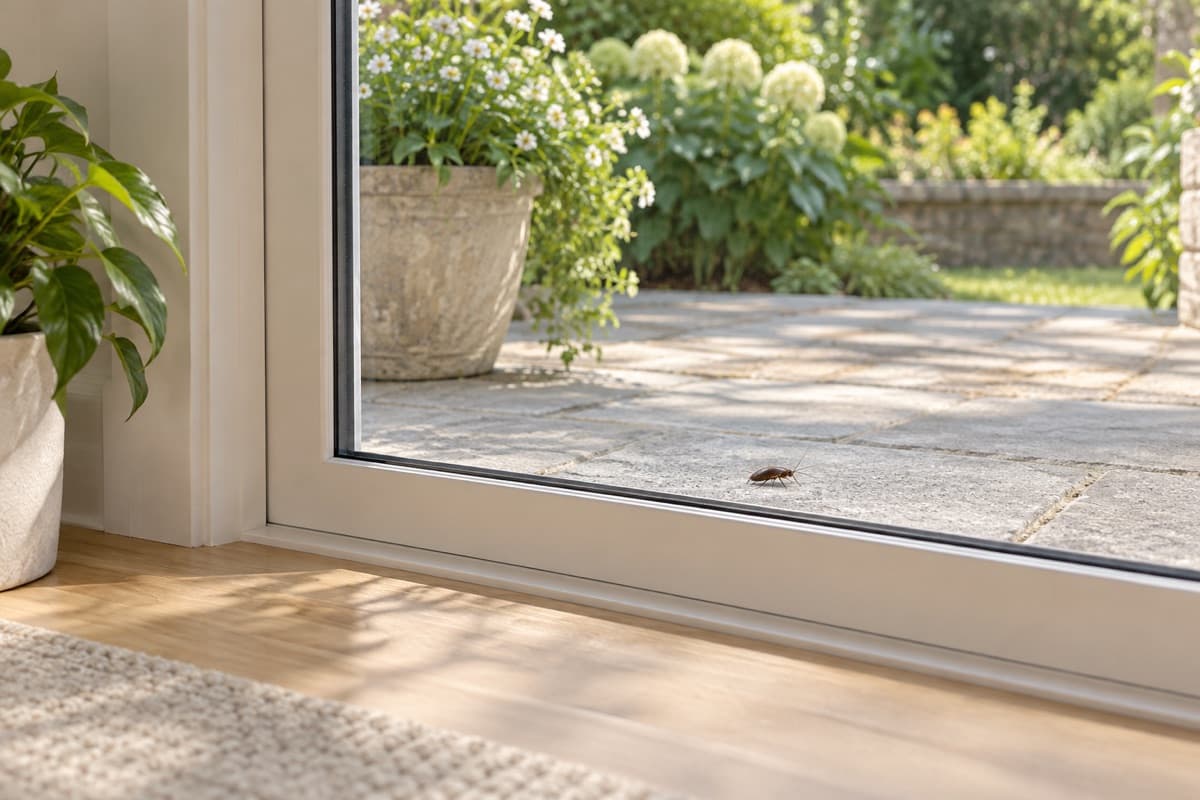
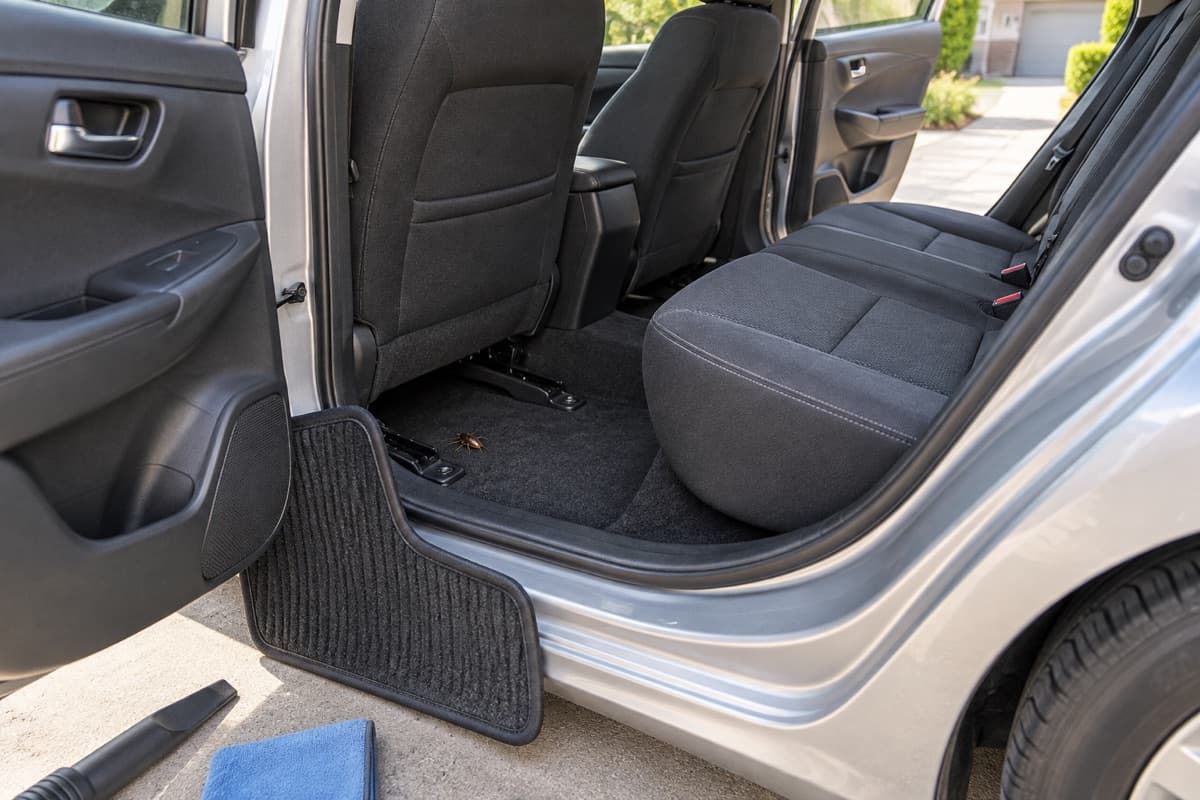
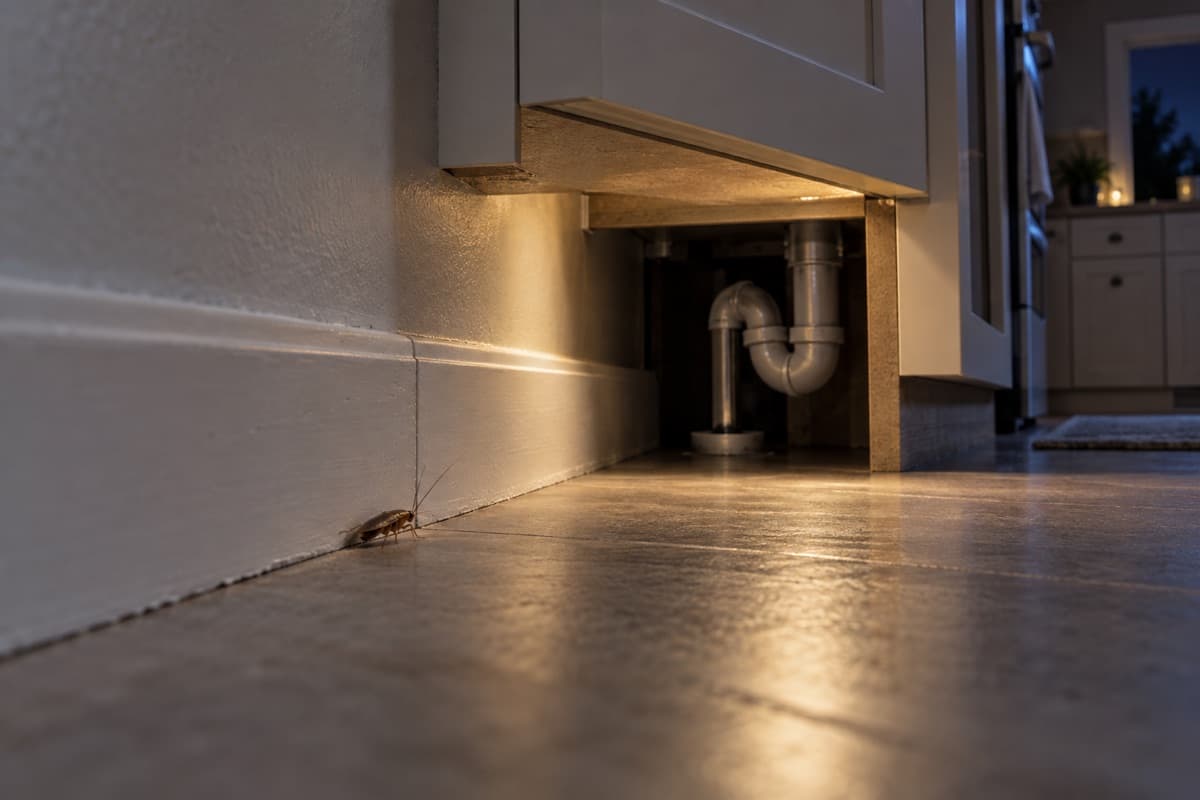
People describe cockroach odor as musty, sour, oily, or stale, and university extension sources treat an unexplained odor as a recognized sign of infestation — the University of Maine notes that cockroaches contaminate food and utensils with excrement and salivary secretions, leaving an unpleasant odor. No published study has characterized the exact volatile mixture that a person smells in an infested kitchen, so anyone who tells you precisely which molecule you are smelling is guessing. What is documented is the chemistry of the two biggest contributors: cockroach feces releases 40 volatile carboxylic acids produced by the insects' gut bacteria, and weathering of cockroach cuticle releases short-chain acids, alcohols, a ketone, and an aldehyde. Those are sour, rancid, and waxy-smelling compound families, which is why the odor reads as musty and greasy rather than simply dirty.
What the Odor Actually Smells Like
There is no standardized vocabulary for this, and descriptions vary because the mixture varies. The consistent threads in how people describe it:
- Musty, like a closed cupboard or a damp cardboard box.
- Sour or slightly sharp, closer to spoiled dairy than to garbage.
- Oily or greasy, a heavy note that lingers on surfaces and in fabric.
- Stronger in enclosed spaces — inside a cabinet, behind a drawer bank, inside an appliance cavity — than in open room air.
The greasy quality is the useful diagnostic. Mold smells musty but not oily. Sewer gas smells sulfurous, not oily. A cockroach harborage tends to smell musty and faintly rancid at the same time.
The Chemistry That Is Actually Documented
Two lines of peer-reviewed work explain most of what you are smelling.
Feces. In a 2015 PNAS study, Wada-Katsumata and colleagues at NC State showed that German cockroach feces owes its attractiveness to volatile carboxylic acids generated by the insects' gut bacteria. They identified 40 such acids in normal feces. Germ-free cockroaches produced feces missing 12 of the major compounds, with 24 more at extremely low levels, and it held roughly a quarter of the total acid content. Nymphs preferred normal feces strongly. The six-compound synthetic blend that reproduced the effect included isovaleric acid, valeric acid, benzoic acid, and phenylacetic acid.
Weathered cuticle. A 2020 study in Proceedings of the Royal Society B found that air, water vapor, and UV break down the unsaturated cuticular hydrocarbons on American cockroaches and release ten volatile compounds: acetic, propanoic, butanoic, pentanoic, and hexanoic acids made up about 68% of the total, with 1-pentanol, 1-octanol, 1-nonanol, 2-nonanone, and tetradecanal accounting for most of the rest. Interestingly, cockroach nymphs avoided shelters exposed to the full mixture, which the authors interpret as a signal of an overcrowded or stale refuge.
Those are the same chemical families behind vinegar, rancid butter, sour milk, and waxy-fatty smells. That is a plausible mechanistic account of "musty and oily" without anyone having to invent a study.
What Is Not Established
Three widely repeated claims did not survive checking, and the previous version of this article made all three.
- That each species has a distinctive smell. The old text asserted that German cockroaches smell sweet and musty, American cockroaches more pungent, and Oriental cockroaches worst of all. We found no extension or peer-reviewed source establishing species-specific odor profiles that a person could use for identification. Use size, markings, and location instead — the confirming signs of a roach problem are physical, not olfactory.
- That the odor comes from "pheromones and fatty acids in their bodies." Half-right at best. The documented fecal aggregation compounds are microbial metabolites, produced by gut bacteria rather than by the insect, and the cuticle-derived volatiles are environmental breakdown products.
- That you can gauge infestation size by odor intensity. No study quantifies a relationship between population density and human-detectable odor. A strong smell means a substantial amount of accumulated frass and harborage material somewhere nearby; it does not translate into a headcount.
What the Odor Does Tell You
Even without a numeric scale, an odor you can smell is informative.
- It indicates accumulation, not a single visitor. One cockroach that wandered in under the door does not produce detectable odor. A smell means deposited material has built up in a harborage over time.
- It points to enclosed, undisturbed space. Odor persists where air does not move: inside cabinet voids, behind appliance panels, under sinks, in wall cavities, inside electronics.
- It often precedes sightings. Cockroaches are nocturnal and stay hidden, so in a moderate infestation the odor is frequently the first thing a household notices.
- It can fade from your own awareness. Continuous exposure dulls perception of a constant background smell, which is why a visitor may notice what residents no longer do. Take a guest's comment seriously.
Where To Search When You Can Smell It but Cannot See It
Work from the strongest smell outward, with a flashlight, in the dark if possible.
- The kitchen core. Under and behind the refrigerator, including the motor compartment and drip pan; under and behind the stove; the dishwasher side panels; the sink cabinet, especially where pipes penetrate the wall and floor.
- Cabinet and drawer voids. Pull drawers fully out and inspect the cavity behind them. Lift shelf liners. Check the underside of the counter overhang and the hollow toe-kick beneath base cabinets.
- Warm equipment. Coffee makers, toaster ovens, microwaves, clocks, and the ventilation slots of electronics. Warmth plus darkness plus crumbs is ideal harborage.
- Moisture points. Water heater closets, washer and dryer surrounds, bathroom vanities, and floor drains. If the odor concentrates near a drain, read how roaches use drains and where they really get in before pouring anything down it.
- Cardboard and paper. Grocery bags, stacked boxes, recycling bins, and pantry cartons are favored harborage and absorb odor.
- Shared walls and chases. In apartments and duplexes, pipe chases and shared voids carry both insects and odor between units.
Trapping beats sniffing for localization. Place dated sticky traps against wall-floor junctions and inside cabinets, check them weekly, and record counts — EPA's child care IPM training recommends exactly that method to find where activity is highest. Why there is no single roach nest explains what you are actually looking for.
Telling Roach Odor From the Things It Gets Confused With
- Mold. Musty, earthy, and tied to damp materials. EPA advises that you may suspect hidden mold if a building smells moldy but you cannot see the source, and recommends keeping indoor humidity below 60%. Mold odor usually strengthens near wet drywall, carpet, or a leak; roach odor strengthens near voids and cracks.
- Sewer gas. ATSDR describes hydrogen sulfide as a colorless gas that smells like rotten eggs, detectable by most people between 0.0005 and 0.3 parts per million, and notes it is commonly called sewer gas. In homes it usually traces to a dried-out floor drain or a rarely used fixture whose P-trap has evaporated. Pour a quart of water down suspect drains and see whether the smell resolves in a day.
- Natural gas. Utility gas is odorized with a sulfur compound so leaks smell like rotten eggs or sulfur. If you smell that and suspect gas, do not investigate — leave the building, avoid switches and flames, and call your gas utility or 911 from outside.
- Dead rodent. A distinctly putrid, sweet-rotten smell that builds over days and then fades over weeks, usually localized to a wall or ceiling cavity.
- Stale drain biofilm. Organic sludge in a kitchen or laundry drain produces a sour smell that is strongest with the water running and improves after cleaning the drain.
Getting Rid of the Smell
Odor is a symptom. It goes away when the source does, and not before.
- Control the population first. Gel bait placed in many small deposits at cracks, corners, and edges is the core method in extension guidance, and a step-by-step roach removal plan sequences it with inspection and sanitation.
- Remove accumulated debris. Frass, shed skins, egg cases, and dead insects all carry odor and allergen. EPA's IPM training directs users to remove them with a HEPA-filtered vacuum, then seal and discard the bag.
- Wet-clean the harborage surfaces. Wear gloves and an N95, wet deposits before wiping rather than sweeping them dry, and wash the cabinet interiors, shelf liners, and appliance panels involved. The same approach applies to the black specks themselves.
- Discard what cannot be cleaned. Infested cardboard, paper bags, and contaminated dry goods should leave the house in a sealed bag.
- Lower moisture and ventilate. Fix drips, run exhaust fans, and air out closed cabinets. Odor lingers longest in humid, still spaces.
- Skip the masking products. Air freshener, scented candles, and essential oils cover the smell and do nothing to the source. If you are considering repellent scents as a control tactic, what the lab data shows about smells roaches hate is worth reading first.
When To Call a Professional
Call a licensed pest control operator if the smell is strong but you cannot locate the source after a careful inspection, if it is coming from inside a wall or ceiling cavity, if you share walls with a unit that may be the origin, if someone in the home has asthma or a cockroach allergy, or if bait and cleanup have not reduced the odor within a few weeks. Persistent odor with no visible activity usually means the harborage is somewhere you cannot reach without opening the structure.
Frequently Asked Questions
Can one cockroach make a room smell?
No. A single insect does not deposit enough material to be detectable. Odor indicates an established harborage with accumulated frass and cuticle debris.
Is the smell itself harmful?
The odor molecules are not the health concern. The concern is the particulate allergen in the same material — cockroach feces, saliva, and body fragments are well-established asthma triggers, which is why the cleanup method matters more than the ventilation.
Why does the smell get worse after spraying?
Insecticide drives cockroaches out of treated cracks and kills them in the open, and dead insects contribute their own decomposition odor. Weathering of cockroach cuticle releases a documented set of acids, alcohols, and carbonyls, and that chemistry continues after death.
Do roaches smell like almonds, or like anything sweet?
We could not substantiate sweet or almond-like descriptions in any authoritative source. If you smell something distinctly sweet, look for a different cause, including a refrigerant or coolant leak.
Can dogs be used to find cockroaches by smell?
Detection dogs are well established for bed bugs and termites. We did not find comparable published validation for cockroach detection, so treat that service claim with skepticism and rely on sticky trap counts instead.
If the smell is gone, is the infestation gone?
Not necessarily. Odor fades once accumulated material is removed and ventilation improves, even if a small population remains. Confirm with trap counts over two to three weeks rather than with your nose.
Sources
- University of Maine Cooperative Extension: Cockroaches — contamination by excrement and salivary secretions and the resulting unpleasant odor.
- Wada-Katsumata et al., *PNAS* (2015), Gut bacteria mediate aggregation in the German cockroach — the 40 fecal volatile carboxylic acids, their microbial origin, and the synthetic blend.
- Hatano, Wada-Katsumata and Schal, *Proceedings of the Royal Society B* (2020) — the ten volatiles released as cockroach cuticular hydrocarbons weather, and the avoidance they cause.
- UC IPM Pest Notes: Cockroaches — species identification, harborage, and the warning that foggers and aerosols can repel and disperse cockroaches.
- EPA: A Brief Guide to Mold, Moisture and Your Home — musty odor as a hidden-mold indicator and the humidity targets.
- ATSDR ToxFAQs: Hydrogen Sulfide — the rotten-egg odor of sewer gas and the concentrations at which people detect it.
- EPA: Managing Cockroaches in Child Care Centers (Module 6) — HEPA vacuuming to remove allergen-bearing debris and dated sticky-trap monitoring.
- University of Kentucky Entomology, Cockroach Elimination (ENTFACT-614) — harborage locations to inspect and gel bait placement practice.