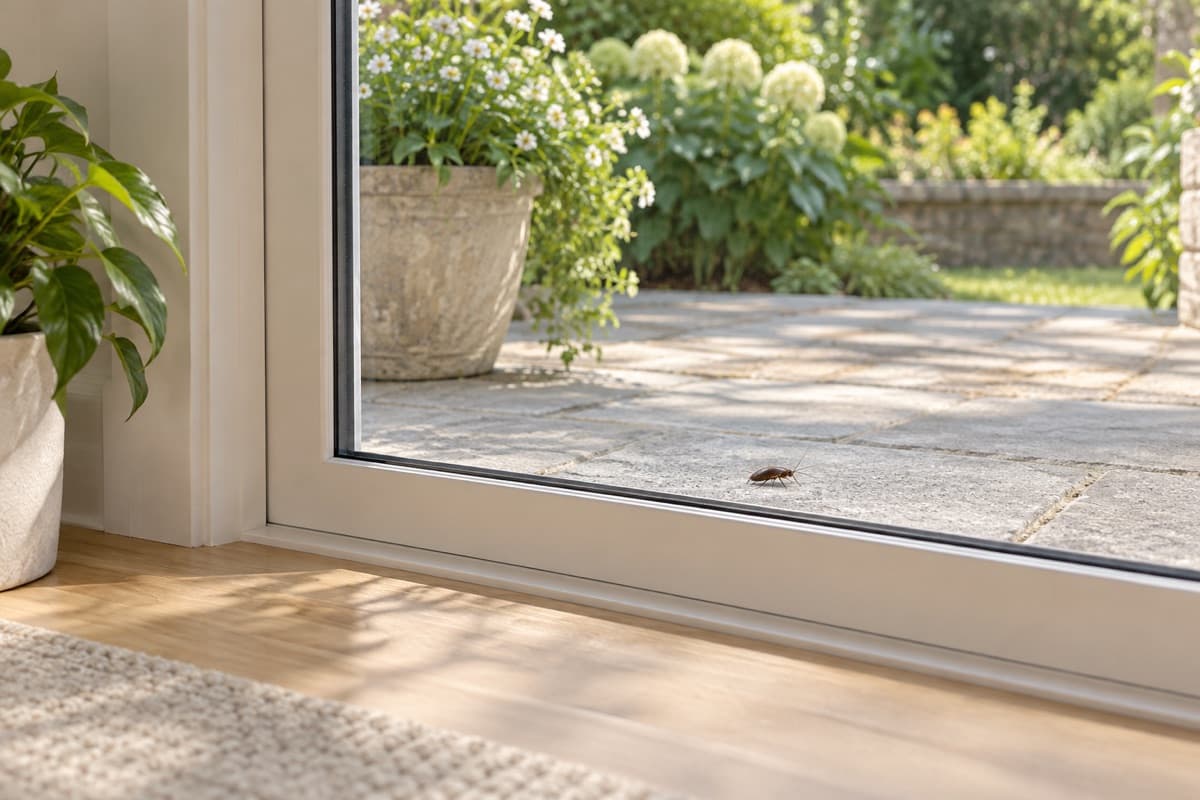
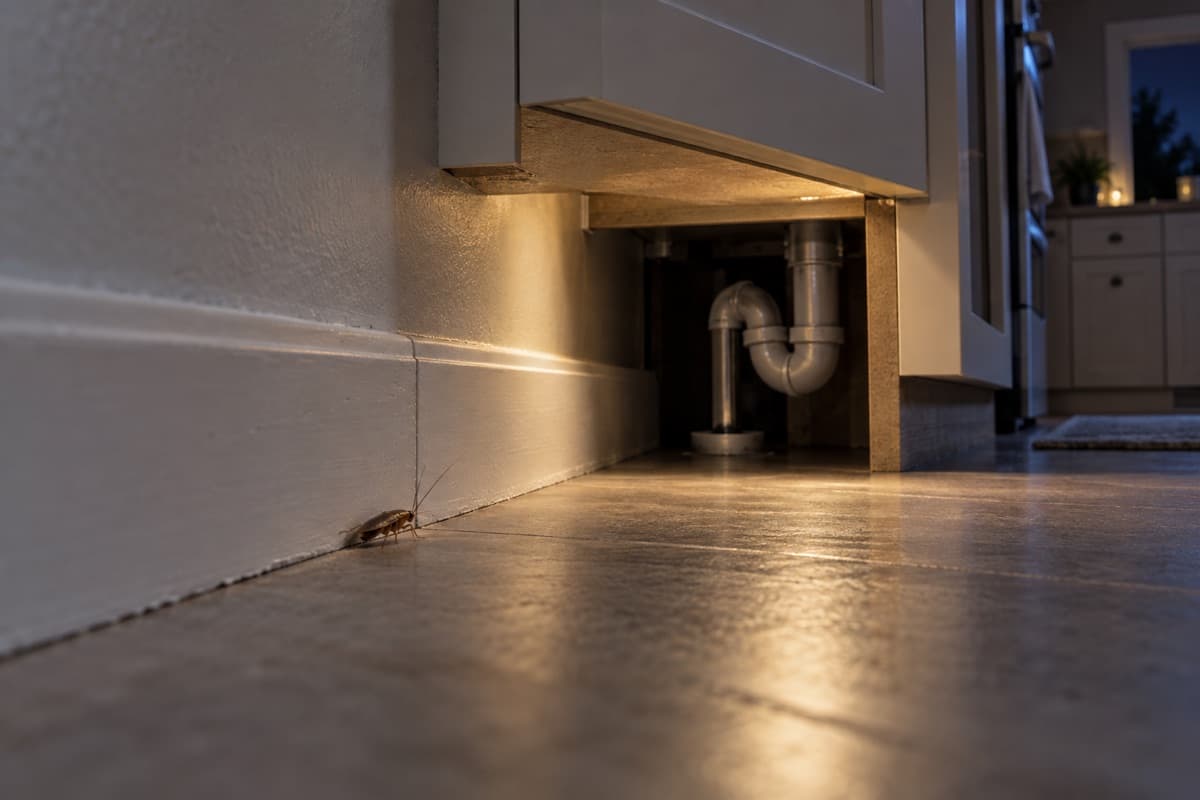
This is a plumbing fix, not a chemistry one. A roach cannot get past a drain trap that is holding water, so the job is to restore and maintain the water seal in every trap, then seal the gaps where pipes pass through walls and floors. UC IPM notes that American cockroaches forage from sewers into the ground floor of buildings "especially if pipes are damaged, screens are missing, or water traps in drains are faulty". Texas A&M AgriLife is equally direct: "American and oriental cockroaches use floor drains as common points of entry into buildings," and the countermeasure is to "keep P-traps filled with water to create a barrier between the sewer and the home or business." Run water in every fixture and floor drain, cap or screen the ones you never use, caulk around pipe penetrations, and put gel bait where the roaches actually forage. Do not pour pesticides, bleach, or drain cleaner into the pipe — EPA's instruction is blunt: "Never pour pesticides down the sink, toilet, sewer, or street drain."
The earlier version of this article recommended boiling water followed by baking soda and vinegar, essential oils poured down drains, borax sprinkled around drain openings, and repellent plants. None of that addresses the actual route. It also repeated the claim that a roach can hold its breath for 40 minutes and survive submerged for half an hour. That figure has no traceable primary source. The research usually invoked for it, a Journal of Experimental Biology study on discontinuous gas exchange in cockroaches, examined a different species and concluded the breathing pattern conserves body water. It says nothing about breath-holding times or submersion, so this version drops it.
What Is Actually Happening Under Your Sink
There are two situations, and they call for different work.
A genuinely dry trap. Every fixture drain has a U-bend holding standing water. The International Plumbing Code requires that liquid seal to be not less than 2 inches and not more than 4 inches deep. That water is the only thing between your bathroom and the sanitary sewer. When a fixture goes unused — a guest bath, a basement shower, a laundry or utility floor drain — the water evaporates and leaves an open pipe. The code treats this as a known failure mode and requires trap seal protection for drains subject to evaporation.
A pipe penetration, not the pipe itself. This is the more common case in a house with normal plumbing use, and it is the one people misread. Drain and supply lines pass through the cabinet floor or back wall through holes cut oversize, often hidden behind a thin escutcheon ring that covers the opening without sealing it. That gap leads into a wall or floor cavity connected to the crawl space or the slab edge. A roach emerging from behind an escutcheon looks exactly like a roach that came up the drain. It walked alongside the pipe instead.
The tell: tape a sticky monitor flat over the drain opening overnight. Catch something in the opening and the trap is the route. Catch roaches on a monitor behind the cabinet but nothing over the drain, and your problem is the wall penetration. Our step-by-step inspection guide applies the same logic room by room.
Which Species Actually Come From Sewers
This distinction decides your whole plan, and most drain advice skips it.
- American cockroach. About two inches, reddish brown, often called a palmetto bug or water bug. UC IPM describes it as "common in sewers, water meter boxes, storm drains, steam tunnels, animal-rearing facilities, and zoos." Penn State Extension states plainly that "American roaches often come up floor drains and sewer pipes." This is the classic single large roach on a ground-floor bathroom floor at night.
- Oriental cockroach. About an inch and a quarter, very dark, glossy, slow. UC IPM says it "lives in cool, dark, damp places like garages, basements, water meter boxes, and drains." A basement, crawl-space, and sump-pit animal.
- German cockroach. About half an inch, tan, two dark stripes behind the head. This one does not live in your sewer. UC IPM calls it "the most common indoor species," living in warm food-preparation areas, and Texas A&M notes that "German cockroaches spend their lives indoors," typically arriving when "brought in with groceries or boxes." Penn State adds adjacent apartment units.
Why it matters: small striped roaches on a kitchen counter mean an indoor breeding population, and sealing drains will not touch it. One or two large reddish-brown roaches a week on a bathroom floor means drains and pipe penetrations are exactly where your effort belongs, and there may be no indoor population at all.
Restore and Hold the Water Seal
This is the highest-value hour you will spend.
- Run every fixture for 30 to 60 seconds. Sinks, tubs, showers, laundry sinks. Flush every toilet, including ones nobody uses.
- Pour water down every floor drain. Texas A&M's school IPM program recommends that infrequently used drains "should be screened to eliminate cockroach access, or flushed weekly with a gallon or so of water to maintain water in the trap." A gallon is the right order of magnitude; a cup will not fill a floor drain trap.
- Put it on a weekly schedule for drains you never use. In a dry climate, or with forced-air heat running, evaporation is faster than people expect.
- Cover unused drains. Penn State recommends rubber drain covers or metal drain screens. A heavy silicone tub-drain cover or a fitted floor-drain cap costs a few dollars.
- Consider a barrier-type trap seal device for a floor drain you cannot keep wet. These are push-in one-way membranes standardized under ASSE 1072 and recognized by the plumbing code. Trade coverage describes the membrane's seal as preventing "sewer gas and insect ingress while also protecting against trap-water evaporation for months."
- If a trap goes dry within days, call a plumber. A trap that will not hold water is usually siphoning because of a venting defect, or leaking. That is a repair, not a chore.
Seal the Gaps Around Pipes
Texas A&M's exclusion guidance is specific: "Use a good-quality caulk or sealant to close the gaps around sinks and plumbing, in walls, and along kitchen splash guards." NPIC gives the same advice, recommending you seal "cracks and crevices around cabinets, backsplashes, windows, doors, crawl spaces, pipes, wires, and cables."
Work the house with a flashlight and a caulk gun.
- Under every sink. Empty the cabinet. Slide the escutcheon ring back and look at the actual hole around the drain tailpiece and both supply lines. Stuff wide gaps with copper mesh or coarse stainless wool, then seal over with silicone or a foam rated for the location.
- Behind the toilet and at the washing machine standpipe, where supply lines and drains enter the wall or floor.
- At the tub and shower valve body, reachable through the access panel if you have one.
- Along the cabinet's wall-floor junction, and around the dishwasher drain line.
- Outside, at the hose bib, the AC line set, and the sewer cleanout. A cleanout with a cracked or missing plug is an open pipe into your yard. Replace it.
Caulk is the finish, not the fix. Anything wider than a pencil needs backing material first, or insects simply push past the thin skin of sealant. The same reasoning applies to roaches appearing at vents and registers, where the opening around the duct matters more than the duct.
What Not To Pour Down The Drain
This is where most drain advice does real harm.
- Pesticides. EPA's disposal guidance is unambiguous, because "many municipal drinking water and wastewater treatment systems are not equipped to remove all pesticides" and "if pesticides reach waterways, they can harm fish, plants, and other living things." NPIC gives the same disposal instruction. It is also usually a label violation, which makes it illegal rather than merely unwise. UC IPM adds that insecticide treatment of storm drains "is not effective nor recommended since these pesticides can contaminate water supplies."
- Bleach. It does not reach the roaches, does not persist, and does not remove the film they feed on. Texas A&M's school IPM program puts it flatly: "A bucket of bleach water is NOT an adequate treatment for a floor drain." Bleach is also the household chemical most likely to hurt you by accident. Washington State's health department warns that mixing it with an acid — a toilet bowl cleaner, a rust remover, vinegar — releases chlorine gas, and that bleach plus ammonia produces chloramines.
- Caustic or acid drain cleaner. Poison Control describes these as containing sulfuric and hydrochloric acids, or sodium and potassium hydroxide, capable of severe chemical burns, with some generating heat in the pipe. They are made to dissolve hair and grease, not to kill insects living in a sewer lateral, and a slug of caustic sitting in a trap is a hazard to whoever next opens that fixture.
- Boiling water. It cools within a few feet of pipe, does nothing to a population in the sewer, and repeated boiling flushes are hard on PVC and ABS joints and on a toilet's wax ring.
- Baking soda and vinegar. They neutralize each other into salt water and carbon dioxide. The fizz is satisfying and mechanically useless. Our separate guide on what to pour down a drain to kill roaches covers the rest of the folk remedies.
Clean The Drain For The Right Reason
One thing is worth putting in the drain, and its purpose is food removal, not killing.
Drains accumulate a biofilm of grease, hair, soap, and food residue on the pipe wall above the water line. Texas A&M notes that drain flies "breed in accumulations of slime that often coat drain walls," and the same film feeds roaches foraging up from below. Removing it makes the drain a less rewarding place to visit.
- Scrub mechanically. A stiff nylon drain brush worked past the strainer and around the tailpiece physically removes the film. This is the part that matters.
- Follow with a biological drain foam or gel. These contain bacteria and enzymes that digest organic residue, and Texas A&M's guidance recommends "one of the excellent bacterial gel products to eat away slime buildup on the insides of drains." Foaming versions expand to contact the full pipe circumference, which a poured liquid does not. Apply at night after last use, and expect to repeat weekly for several weeks.
One caution: a biological product and a disinfectant cancel each other out. Bleach the drain on Monday and the bacterial foam you apply Tuesday is wasted.
Bait And Monitor, Do Not Spray
For the roaches already inside, Texas A&M's assessment is that "baits are among the most effective insecticides for controlling cockroaches in homes," while "total-release aerosols (bug bombs) generally do not eliminate cockroaches because they do not penetrate the cracks where most cockroaches hide."
- Place gel bait in crack-and-crevice spots near the plumbing — back corners of the sink cabinet, the hinge side of the door, behind the toilet, along the vanity base, in the crawl space near the sewer lateral. Never on the drain itself, where it washes away. Our walkthrough of a common gel bait label shows how small a correct placement actually is.
- Set sticky monitors flat against the wall behind the toilet, under the sink, and beside the floor drain. NPIC and UC IPM both treat sticky traps as the primary way to detect and measure a population, and for a sewer problem they tell you whether the traffic is one insect a week or twenty.
- Skip indoor perimeter sprays. Residual spray over bait can make the bait unattractive, and nothing on a cabinet floor reaches an insect that is still in the sewer at midnight.
- Reduce outdoor pressure if American or smokybrown roaches are the issue. Leaf litter, mulch against the foundation, firewood, and standing water in meter boxes all support the population that later finds your drain. Our guide to lowering roach pressure in the yard covers the specifics.
When It Is The Building, Not Your Unit
Some drain roach problems cannot be solved from inside one home.
Signs the problem is structural: roaches appear in several units at once, they show up after heavy rain or a sewer backup, you smell sewer gas, a floor drain gurgles, or a trap keeps going dry no matter how often you fill it. Any of those points to a plumbing defect — a broken or unvented drain line, a failed trap, a missing cleanout plug, a damaged building sewer — that a plumber needs to find, often with a camera.
UC IPM also cautions that "Don't expect treatment of sewers to eliminate the problem," though some sanitary sewer agencies do run a response program for cockroaches coming out of sewers. A call to your municipal wastewater utility is worth making if the problem is neighborhood-wide.
In rental housing, building-envelope exclusion and plumbing repairs are the landlord's responsibility, and EPA's guidance for housing managers frames effective control in multifamily buildings as a coordinated effort among residents, maintenance staff, and a pest professional rather than something a tenant can do alone. Report it in writing and keep dated photos. If the pressure is coming from the unit next door rather than the sewer, our guide to roaches from neighboring units covers how to get several units treated together.
DIY Or Call A Pro?
Handle it yourself when you are seeing one or two large roaches a week in a ground-floor bathroom, the traps are easy to reach and fill, and the pipe penetrations under your sinks are visible and caulkable. That is a weekend with a caulk gun, a drain brush, copper mesh, and a tube of gel bait.
Call a plumber when a trap will not hold water, a drain gurgles or drains slowly, you smell sewer gas, the cleanout plug is missing, or you suspect a break in the building sewer. No amount of pest control fixes an open pipe.
Call a pest management professional when small striped German cockroaches are involved, when you see roaches in daylight, when more than one room is affected, or when someone in the home has asthma. NPIC notes that indoor cockroach infestations can worsen allergy and asthma symptoms because waste products get into the air, which raises the stakes on both the infestation and on any pesticide you might apply yourself.
Frequently Asked Questions
Can roaches swim up through a trap full of water?
Not under normal conditions. A trap holding a 2- to 4-inch water seal is a physical barrier, which is why the plumbing code requires it. The realistic paths are a dry or faulty trap, a damaged pipe, a missing screen, or the unsealed gap around the outside of a pipe. If a trap is full and the fixture is in daily use, look at the penetration instead.
Do roaches come up through toilets?
Rarely. A toilet has its own integral trap, refilled on every flush. A toilet in a vacant unit or unused basement bath can lose its seal to evaporation. More often, a roach seen near a toilet came through the gap where the supply line enters the wall, or from behind the base.
Will a drain cover alone solve it?
It helps, especially on floor drains and unused fixtures, but it does nothing about wall and floor penetrations, and a loose strainer with wide slots will not stop an insect. Treat covers as one layer, not the answer.
How long before I stop seeing them?
If the route was a dry trap or an open penetration, sightings usually drop off within days of sealing, because the roaches were commuting rather than breeding indoors. Still seeing the same numbers after two weeks of maintained traps and sealed penetrations means you missed an opening, or you have an indoor population instead.
Is a roach in the drain a health risk?
Worth taking seriously for two reasons. UC IPM notes that because American cockroaches may contact human waste in sewers, they are capable of transmitting bacteria that cause food poisoning. Separately, cockroach allergens are a recognized asthma trigger. Clean and disinfect food-contact surfaces where roaches have walked, and keep the sink basin clear overnight.
Does pouring bleach down the drain nightly keep them out?
No. It does not reach a population living in the sewer lateral, it does not persist, and it degrades any biological drain treatment you are using. It also introduces a real hazard if it meets an acidic cleaner in the same trap. Water in the trap and sealant around the pipe do the work bleach is being asked to do.
Sources
- UC IPM Pest Notes: Cockroaches — American cockroaches in sewers and storm drains, entry where "pipes are damaged, screens are missing, or water traps in drains are faulty," Oriental cockroach habitat, German cockroach as the main indoor species, sticky-trap monitoring, the warning against treating storm drains with insecticide, and the limits of sewer treatment.
- Texas A&M AgriLife Extension: Cockroach Biology and Management — floor drains as entry points for American and Oriental cockroaches, keeping P-traps filled, caulking around sinks and plumbing, baits as the most effective insecticide class, and why foggers fail.
- Texas A&M School IPM: The Science of Drainology — slime on drain walls, bacterial gel products, screening or weekly gallon flushing of infrequently used drains, and that bleach water is not an adequate floor drain treatment.
- Penn State Extension: Got Roaches? Eliminate Roaches with IPM — American roaches coming up floor drains and sewer pipes, Oriental roaches in wet basements, German roaches arriving via boxes and adjacent units, drain covers and screens, and caulking with silicone and copper mesh.
- NPIC: Cockroaches — sealing cracks around pipes and cabinets, monitoring with sticky traps, IPM before pesticides, and cockroach allergens worsening asthma.
- International Plumbing Code Section 1002, Trap Requirements — the 2-to-4-inch trap seal depth and the recognized trap seal protection methods, including ASSE 1072 barrier-type devices.
- The Construction Specifier: Understanding Trap-Seal Protection Devices — how one-way membrane devices block sewer gas and insect ingress and slow trap water evaporation.
- EPA: Safe Disposal of Pesticides and NPIC: Disposal of Pesticides — never pour pesticides down a sink, toilet, sewer, or street drain, and why treatment systems do not remove them.
- Poison Control: What's in drain cleaner? — caustic and acid ingredients, burn risk, and heat generated in the pipe. The poison center line is 1-800-222-1222.
- Washington State Department of Health: Dangers of Mixing Bleach with Cleaners — chlorine gas from bleach plus acid, chloramines from bleach plus ammonia.
- EPA: Pest Control Resources for Housing Managers — IPM in multifamily housing as a coordinated effort among residents, staff, and pest professionals.
- Schimpf et al., *Journal of Experimental Biology* (2009), via PubMed — discontinuous gas exchange in cockroaches as water conservation; the study commonly miscited for the "40-minute breath hold" claim, which it does not support.