Unplug the device at the wall and disconnect or remove the battery before you touch anything. If it is a mains-powered appliance or a sealed unit — a microwave, TV, refrigerator, washer, oven, desktop power supply, or anything marked "no user-serviceable parts inside" — do not open it. Capacitors inside can hold a dangerous charge long after the cord is out. Send it to qualified service or replace it. If it is a device you can legitimately open, such as a desktop PC case, a game console, a keyboard, or a router with an external power brick, work outdoors over a lined bin: lift dry droppings off with a soft brush while a HEPA vacuum catches the debris nearby, then clean the remaining film with 99% isopropyl alcohol on a lint-free swab and let the board dry completely before power goes anywhere near it. Never put insecticide, dust, bait, or fogger spray inside or around electronics. And treat the droppings as evidence of an infestation in the room, not a defect in the gadget.
That last point matters more than the cleaning technique. Cockroach droppings are not just waste — they are a recruitment signal. The German cockroach's aggregation pheromone was isolated from frass-contaminated filter paper, and researchers have since shown that gut bacteria in the feces produce the volatile compounds that draw other roaches to a shelter. A warm device streaked with droppings is, chemically speaking, advertising itself. Cleaning the board without dealing with the room just resets the clock.
First, Cut The Power And Contain The Device
Do these five things before you decide anything else.
- Unplug it at the outlet, and disconnect or remove the battery. The power button is not an isolation point. For a laptop or anything with an internal cell, follow the manufacturer's or a reputable repair guide's battery-disconnect step before the board is exposed.
- Do not power it on to "see if it still works." Energizing a board with conductive debris across it is exactly when a short happens, and the heat and airflow push live roaches deeper into the housing.
- Move it out of the living space. Take it outside, to a garage, or set it over a lined trash can. You want roaches leaving the device somewhere other than your desk.
- If you cannot work on it today, bag it. A heavy-duty plastic bag, taped shut, keeps the population from spreading to the next room. Containment is not a treatment — it does not clean the device and it will not reliably kill what is inside — but it buys you time.
- Glove up, and do not dry-sweep or blow debris around indoors. Cockroach droppings, saliva, shed skins, and body fragments are well-documented asthma triggers; the EPA lists cockroach debris among the indoor triggers to control. Nitrile gloves and, if anyone in the house is asthmatic, an N95 are reasonable. Our guide to cleaning roach droppings covers the rest of the precautions.
Take a few photos while you are at it. If this turns into a landlord conversation, a warranty claim, or a renter's insurance claim, you will want them.
Sort Your Device Into One Of Three Categories
Almost every bad outcome in this job comes from opening something that should not be opened. Sort first.
Category 1 — Do not open. Service or replace. Microwaves, TVs and monitors, refrigerators, washers, dryers, ovens, dishwashers, HVAC and furnace control boards, desktop PC power supply units, anything hard-wired, and anything labeled "no user-serviceable parts inside."
The issue is stored energy. OSHA's electrical work-practice standard requires that capacitors be discharged and high-capacitance elements short-circuited and grounded before work begins, because stored charge can remain after the equipment is de-energized. Microwave ovens are the extreme case: UC Berkeley's environment, health and safety office warns that the high-voltage capacitor can hold a dangerous charge even when the oven is unplugged, and NIOSH investigated a fatality in which an appliance repair worker was electrocuted while diagnosing a microwave oven. That was a trained technician in a repair shop. A kitchen table is not the place to improve on that.
Category 2 — Openable, low-voltage, with a published teardown. Desktop PC interiors (clean the motherboard, leave the power supply unit sealed), game consoles, mechanical keyboards, mice, routers and modems that run off an external wall adapter, remote controls, and laptops if you are comfortable and a proper guide exists. The test is simple: the device runs on low-voltage DC from an external or removable supply, and there is a documented way in that starts with disconnecting the battery.
Category 3 — Sealed consumer electronics. Phones, tablets, smart speakers, earbuds, smart thermostats, streaming sticks. These are glued and gasketed. Clean the exterior, and if droppings are visibly inside, that is a repair-shop job or a replacement decision — not a screwdriver-and-YouTube job.
One practical note before you pry anything: opening a device usually ends its warranty, and infestation damage is frequently excluded from service coverage anyway. LG's flat rate repair program, for example, lists damage from insect or vermin infestation among the things it will not cover. Call the manufacturer before you open something expensive, not after.
What Roach Droppings Actually Do Inside Electronics
It is worth being precise here, because a lot of what circulates online is guesswork.
They keep the device attractive to more roaches. This is the best-documented effect, and the reason "it still works, I'll leave it" is a poor plan. Frass marks the shelter as occupied and safe.
They are organic, moisture-holding debris sitting on live conductors. Contamination plus humidity is a recognized reliability problem in electronics, not a folk theory. NASA's corrosion-protection standard for flight hardware attributes corroding circuitry to a combination of humid environments and contamination — the collection and deposition of debris, oils, and dirt, and the long-standing environmental test standard MIL-STD-202 describes how absorbed moisture and surface wetting of insulation lead to corrosion of metals and detrimental changes in electrical properties. Droppings hold moisture against the board. That is the mechanism worth taking seriously.
Bulk debris blocks airflow and bridges contacts. Bodies, shed skins, and egg cases accumulate in fan housings, heatsink fins, and vents, which drives temperatures up. A dead roach lying across two adjacent contacts is a physical bridge, whatever its chemistry.
They shed allergens every time you disturb them. That is the health cost, and it is the reason the cleanup happens outdoors with a HEPA vacuum rather than with a can of air at your desk.
What you will also read is that roach droppings are strongly acidic and actively etch copper traces. We could not find an authoritative measurement of frass pH or of corrosion rates on printed circuit boards to support that specific claim, so we are not going to make it. You do not need it. Moisture-retaining organic debris on a powered board in a humid house is reason enough to clean, and if you are looking at the small dark specks and trying to confirm what they are, this guide to the black dots roaches leave behind will help you tell frass from ordinary dust.
Cleaning A Board You Can Safely Reach
This section applies to Category 2 devices only. Budget an hour, most of it drying time.
What you need: 99% isopropyl alcohol, lint-free swabs and wipes, a soft anti-static brush or a new soft-bristle toothbrush, a vacuum with a HEPA filter and a brush attachment, nitrile gloves, heavy trash bags, and good light.
- Set up outdoors or in a garage, over a lined bin. Confirm the device is unplugged and the battery is disconnected. Give it a few minutes after unplugging so low-voltage rails drain.
- Ground yourself. Touch bare metal on the chassis, or wear an anti-static strap. Electrostatic discharge ruins boards more quietly than roaches do — there is no visible damage, just a device that no longer works.
- Remove loose debris dry, first. Tip the chassis over the bag and let gravity do the work. Brush gently along fins, seams, and connector shrouds, and hold the vacuum nozzle near the board — not against it — to catch what you dislodge. Do not drag a vacuum nozzle across components. Dell's laptop fan cleaning guidance is blunt about not using a household vacuum on internals, because the suction can damage parts. The vacuum's job here is capturing airborne debris and cleaning the case, not scraping.
- Use compressed air only if it genuinely fits. Outdoors, on an opened device, where you can see that you are blowing debris out rather than deeper into a housing. Hold fan blades still with a swab so they cannot spin up — Dell recommends this to avoid stressing the bearings. Use short bursts, keep the can upright, and never tilt it: canned dusters are not air but liquefied fluorocarbon propellant, and a tilted can sprays cold liquid onto your board. The EPA's fact sheet on compressed air dusters spells out what is actually in them. Skip compressed air entirely on sealed devices, on anything you could not open, and anywhere indoors.
- Then wet-clean the residue. Dampen — do not soak — a lint-free swab with 99% isopropyl alcohol and work from clean areas toward dirty ones. Concentration matters: iFixit's electronics water damage guide calls for 90% or higher and warns against drugstore "rubbing alcohol," which is often 70% or less and carries additives. The remaining 30% in that bottle is water, which is precisely what you do not want on copper.
- Soften baked-on droppings instead of scrubbing them. Let the alcohol sit for 30 to 60 seconds, then lift the softened residue with the soft brush using almost no pressure. Surface-mount components are tiny and snap off easily.
- Do not substitute anything else. No water, soapy water, vinegar, glass cleaner, bleach, ammonia, all-purpose spray, penetrating oil, or abrasive pads. Repair shops do run fully removed boards through ultrasonic baths and high-purity solvent; that is a bench process with controlled drying, not a kitchen-sink one.
- Treat screens and coated plastics differently. Isopropyl alcohol strips anti-glare and oleophobic coatings. LG's screen cleaning instructions are to unplug the set, use a soft dry microfiber cloth, never spray liquid directly onto the TV, and avoid alcohol, ammonia, and solvent-based cleaners entirely.
- Dry it completely. Several hours of air drying in a warm, dry room. No hair dryer, heat gun, or oven — heat warps plastics, damages components, and bakes contamination in place. Reassemble only when everything is bone dry.
- Power up deliberately. Plug in, watch, and smell. If the breaker trips, the device sparks, it smells like hot plastic, or it behaves erratically, unplug it and stop. That device is finished.
- Close out the cleanup. Seal the debris bag and put it in an outdoor bin immediately, empty the vacuum canister outside, wipe down the desk or shelf the device sat on, and wash your hands for at least 20 seconds.
What Never Goes Inside An Electronic Device
No insecticide of any kind — spray, aerosol, dust, gel, or bait station — inside a device, in its vents, or in its case. No consumer roach product is labeled for application inside electronics, and that is not a technicality. Pesticide labels are legally enforceable: under FIFRA, using a registered pesticide in a manner inconsistent with its labeling is a violation of federal law, which the EPA restates plainly — the label is the law. Beyond that, the solvents, surfactants, and oils in these formulations leave exactly the kind of residue you are trying to get off the board — and aerosol propellants are flammable around live contacts.
No foggers or bug bombs in a room where electronics matter. The EPA's safety precautions for total release foggers tell you to unplug electrical appliances and shut off every ignition source, including appliances that cycle on and off, and to keep the fogger at least six feet from any ignition source, because fogger contents can catch fire. They also do not work well: UC IPM notes that aerosols and total-release foggers often fail to reach the crevices where cockroaches harbor and may disperse them into other areas, and the National Pesticide Information Center describes the same settling-on-surfaces problem.
No powders — including diatomaceous earth, boric acid, or anything sold as "food grade." Loose powder migrates into fans, bearings, connectors, and switch contacts. It is abrasive, it holds moisture, and it will not come back out.
No essential oils, peppermint spray, or vinegar. Oils leave a sticky residue that collects dust and does nothing to an established population. Vinegar is dilute acid in water — the two things you least want touching copper and steel.
No heat and no freezing. Running the device hot, baking it, or aiming a heat gun at it will not sanitize anything; it damages components and fuses contamination to the board. Freezing a device drives condensation onto it as it warms back up.
No working on it live, and no reassembly while damp. ESFI's DIY electrical safety guidance is to unplug before working on an appliance and to verify the power is actually off.
Repair, Replace, Or Hand It To Service
Clean it and keep it if the droppings are on surfaces you can reach and see, the device is in Category 2, there is no corrosion or scorching, and it runs normally with no odd smell after a full dry-out.
Hand it to qualified service if it is a Category 1 appliance you depend on, it is still under warranty, or the replacement cost is high. Call the manufacturer's service line first and describe the problem honestly, including the infestation — it changes what they will quote and whether they will accept it.
Replace it if any of these are true:
- You see green or white crusty deposits on traces, connector pins, or solder joints. That is corrosion that has already progressed, and cleaning it at home rarely restores reliability.
- There is melted plastic, a scorch mark, a burnt smell, or insulation that looks chewed, cracked, or nicked.
- It trips a breaker, sparks, runs unusually hot, or behaves intermittently after cleaning.
- There are live roaches or egg cases inside a housing you cannot fully open, reach, and verify.
- The repair estimate approaches replacement cost, which it often does once insect damage falls outside the coverage terms.
ESFI's appliance safety guidance puts the disposal side simply: take a damaged appliance to an authorized repair center, or cut the cord, dispose of it safely, and buy a new one. OSHA applies the same logic in workplaces — damaged equipment comes out of service until repairs make it safe. A $40 router is not worth deliberating over.
Disposing Of A Device You Cannot Save
- Bag and seal it before it leaves the room. Do not carry an open, infested device through the house.
- Do not donate it, sell it, or leave it at the curb for scavengers. You would be handing someone else an infestation, and possibly a fire risk.
- Cut the cord on a discarded appliance so no one retrieves and plugs it in.
- Route it to e-waste recycling, not the trash — especially anything with a battery. The EPA is explicit that lithium-ion batteries and the devices containing them do not belong in household garbage or curbside recycling bins, because damaged cells short and ignite in collection trucks and sorting facilities. Take them to a battery or electronics recycler or a household hazardous waste collection point, and tape the terminals of any loose battery with non-metallic tape first.
- Tell the recycler or repair shop it is roach-contaminated. Some will decline it, and they are entitled to know before they open it on a shared bench.
- Clean the space it occupied — vacuum the shelf, cable runs, and wall gap, then wipe with hot soapy water.
The Real Fix Is The Room, Not The Board
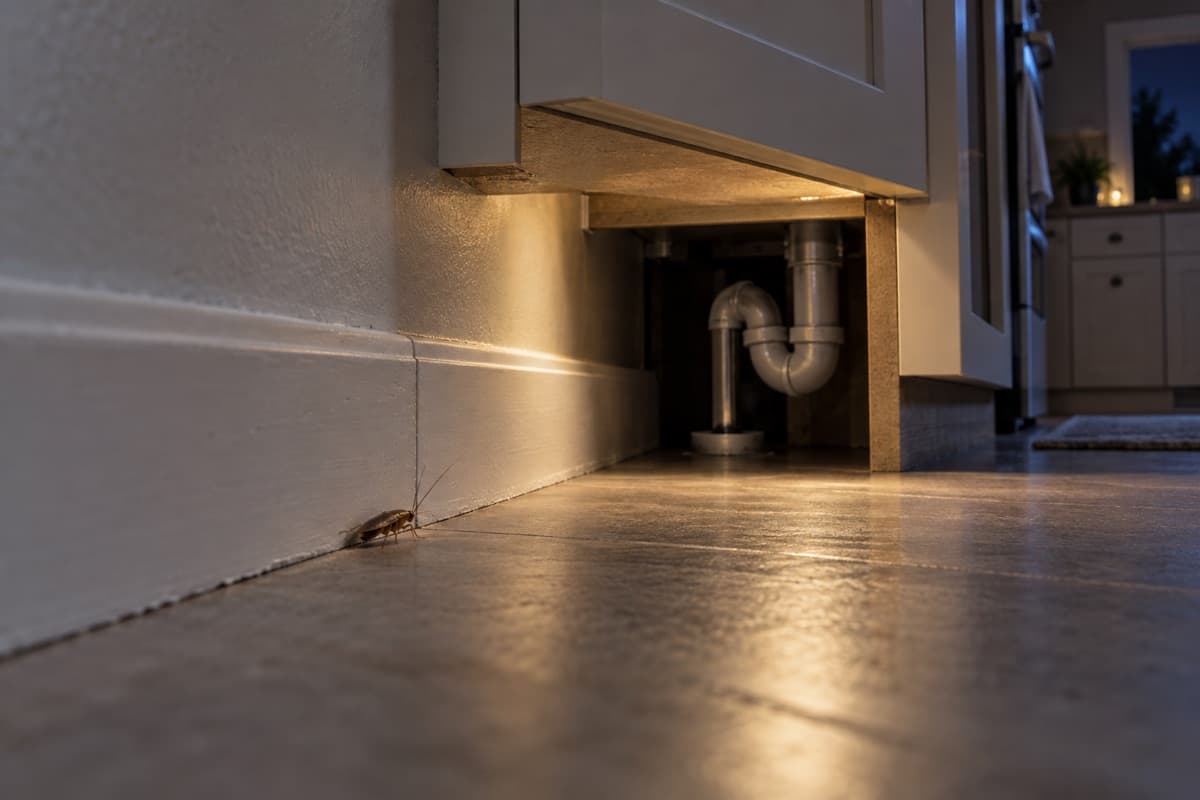
If roaches were inside your electronics, they are also in the voids around them. German cockroaches shelter in exactly this kind of warm, tight, dark space — behind and under appliances, inside cabinet corners, along plumbing runs — as NC State Extension's German cockroach guide describes. And they compound quickly: Penn State Extension notes a single egg capsule can hold up to 48 eggs, with four to eight capsules per female over her lifetime.
- Monitor before you treat. Put glue boards flat against walls, behind the TV stand, under the desk, in cabinet corners, and under the sink. Where they fill fastest tells you where the harborage is — which is the point of finding the nest rather than chasing individual roaches. If you are not sure the problem is established, these are the signs to look for.
- Clean before you bait. Baits work by being the most attractive food available, so competing crumbs and grease directly undercut them. Sanitation first is standard extension advice for a reason.
- Use gel or granular bait in pea-sized placements near harborage, following the product label exactly, away from food-preparation surfaces, and out of reach of children and pets. UC IPM identifies baits as the primary indoor pesticide for cockroach control, and they work slowly — give it a week or more.
- Skip the perimeter sprays. Repellent sprays push roaches deeper into wall voids and away from the bait you want them eating.
- Vacuum as you go, with a HEPA filter. University of Minnesota Extension notes that vacuuming effectively removes cockroaches and egg cases when combined with other methods, and a HEPA filter keeps the allergen-heavy dust from going airborne.
- Seal the routes in. Caulk cracks along baseboards and cabinet corners, and close gaps around plumbing and cable penetrations. Wall voids and switch boxes are a genuine highway between rooms and between units, which is why roaches turn up in outlets in the first place.
- Give your electronics air and light. Do not shove a console, receiver, or tower flush against the wall. A few inches of open, wipeable space makes the gap far less attractive and lets you actually clean back there.
- Stop eating at the desk. Crumbs in a keyboard are a food source parked on top of a circuit board.
- If you rent, notify your landlord or property manager in writing. Roaches move between units through shared walls, plumbing chases, and outlet boxes, and unit-by-unit treatment rarely holds.
When To Call A Professional
Two different professionals may be involved, and it is worth knowing which.
Call a licensed pest management professional if:
- You see roaches during the day, or in more than one room. Daytime activity usually means the population has outgrown its hiding places.
- You are finding them in multiple appliances or devices — a TV, a game console, and the microwave is not three problems, it is one.
- You find egg cases, shed skins, or a persistent musty odor.
- Activity continues four to six weeks after consistent sanitation and correct baiting. Bait aversion and insecticide resistance are both documented in German cockroach populations, and a professional can rotate active ingredients.
- Someone in the household has asthma or significant allergies.
- You live in a shared building, or suspect the source is a neighboring unit.
Call an appliance technician or a licensed electrician if a mains-powered device shows any sign of electrical damage, if a breaker trips, if wiring insulation is compromised, or if the device is hard-wired. Do not bridge that gap with a screwdriver and a video.
Frequently Asked Questions
Can I use the rubbing alcohol from my medicine cabinet?
Not ideally. Most drugstore rubbing alcohol is 70% or less, meaning nearly a third of what you are applying is water, and some formulations include added oils or fragrance that leave residue. Use 99% isopropyl alcohol, sold at hardware stores and electronics suppliers; iFixit's guidance is 90% at minimum.
Is compressed air safe for blowing roach droppings out of electronics?
Only in narrow circumstances: outdoors, on a device you have actually opened, with the fan blades held still, the can upright, and a clear path for debris to exit. Used on a sealed device or through a vent slot, you are usually just relocating droppings and allergens deeper inside or into the air you are breathing. A soft brush and a HEPA vacuum are the safer default.
Can I rinse a circuit board with water or soap?
Not as a home process. Manufacturers do use aqueous cleaning with deionized water, controlled chemistry, and forced drying, and repair shops use ultrasonic baths — none of which resembles a sink and a towel. Tap water leaves mineral and ionic residue behind, which is the opposite of what you want.
I found roaches inside my TV or microwave. Can I open it up and clean it?
No. Both fall in the do-not-open category, and microwaves in particular contain a high-voltage capacitor that holds a dangerous charge after unplugging. Unplug it, clean the exterior and vents with a dry microfiber cloth, and then decide between manufacturer service and replacement.
Should I put a bait station or spray insecticide inside the case to kill what is in there?
No. It is inconsistent with every consumer product label, it leaves conductive and flammable residue among live contacts, and it will not reach roaches sheltering in a housing anyway. Bait goes near harborage in the room, not inside the device.
The device still works. Do I have to do anything?
Clean what you can safely reach, and deal with the infestation. Droppings inside a warm device keep signaling other roaches to move in, and disturbing them later releases allergens. But "clean what you can safely reach" does not become "open the microwave" because the droppings bother you.
How do I know the cleaning worked?
You do not, entirely — which is why the decision framework matters more than the technique. If you could see, reach, and clean every contaminated surface, the device dried fully, and it runs normally with no smell or heat problem, you are in reasonable shape. If any of those is a guess, treat it as a replacement candidate rather than assuming the best.
Will roach droppings inside a device eventually cause a fire?
Direct evidence linking cockroach frass to residential fires is thin, and we are not going to overstate it. The realistic risks are corrosion, blocked airflow and overheating, and shorts from bulk debris or dead insects bridging contacts. Chewed or damaged wiring insulation, whatever caused it, is the finding that should take a device out of service immediately.
Sources
- OSHA 1910.333, Selection and use of work practices and 1910.334, Use of equipment — discharging capacitors before work, and removing damaged equipment from service.
- UC Berkeley EH&S: Microwave oven safety guidelines and NIOSH FACE report: appliance repair worker electrocuted servicing a microwave oven — why microwave interiors are not a DIY space.
- ESFI: DIY electrical safety and ESFI: Appliance safety tips — unplugging before service, and what to do with a damaged appliance.
- iFixit: Electronics water damage — isopropyl alcohol concentration, and why drugstore rubbing alcohol is the wrong product.
- Dell: How to clean a laptop fan safely — holding fan blades still, and vacuum suction risk to internals.
- LG: How to clean your TV screen and LG: Flat rate repair program — manufacturer cleaning method, and insect/vermin infestation as a repair exclusion.
- NASA-STD-6012A, Corrosion protection for space flight hardware and MIL-STD-202 — humidity plus contamination as a cause of corroding circuitry and degraded electrical properties.
- NPIC: Regulation of pesticide labels and EPA: Introduction to pesticide labels — the label is legally enforceable under FIFRA.
- EPA: Safety precautions for total release foggers and NPIC: Total release foggers — unplugging appliances, ignition sources, flammability, and poor penetration into harborage.
- UC Statewide IPM Program: Cockroaches — baits as the primary indoor pesticide, and why aerosols and foggers disperse rather than control.
- NC State Extension: German cockroach surveillance and management and Penn State Extension: German cockroaches — harborage preferences and reproductive rate.
- University of Minnesota Extension: Cockroaches — HEPA vacuuming to remove cockroaches and egg cases.
- EPA: Asthma triggers — gain control — cockroach droppings and body parts as indoor asthma triggers.
- EPA: Used lithium-ion batteries and EPA: Compressed air dusters fact sheet — battery disposal and what aerosol dusters actually contain.
- Applied Entomology and Zoology: The aggregation pheromone of the German cockroach and Science: Cockroaches communicate via bacteria in their feces — why frass attracts more cockroaches.