A boric acid dust application is not a timed treatment you pick up after a set number of days. Applied correctly — a thin, barely visible film inside cracks, crevices, and voids that stay dry and undisturbed — it can keep working for months. What it will not do is work quickly: UC IPM notes that boric acid powder "has fairly slow activity, and it may be 7 days or more before it has a significant effect on a cockroach population." So plan on leaving it in place for weeks, not days, while you check sticky traps every two to four weeks and replace any deposit that gets wet, caked, swept, or disturbed. Whatever the specific product label on your container says about placement, reapplication, and cleanup overrides every general timeframe here — including this one.
That last sentence is the part worth internalizing. "How long do I leave it down?" sounds like a question with one number for an answer, but boric acid is sold under dozens of different EPA registrations with meaningfully different directions, and the directions on the container you bought are the legally enforceable ones.
Why "How Long" Is Slightly The Wrong Question
Boric acid is a slow-acting stomach poison, not a knockdown spray. UC IPM describes the mechanism plainly: because the dust carries a positive electrostatic charge, it clings to a cockroach walking through a treated area, and the insect swallows small amounts while grooming itself. Nothing about that process happens on a schedule you set.
So the useful framing is not how many days until I sweep it up but is there still an intact, dry, thin film of dust in the places roaches actually travel? If yes, the treatment is live and should stay. If the deposit is gone, damp, clumped, or sitting out in the open where it does no good and creates exposure, it needs attention regardless of whether you applied it three days or three months ago.
UC IPM's summary of longevity is the closest thing to a real answer: "If it remains dry and undisturbed, boric acid provides control for a very long time." Some consumer labels put a rough floor on it — the label for Harris Famous Roach Powder, a 99% boric acid product, states the product keeps killing roaches and silverfish "for weeks after application as long as it's kept dry." Neither statement is a countdown. Both are conditional on dryness.
Know What You Actually Bought
Three different things get called "boric acid for roaches," and they are not interchangeable.
- An EPA-registered boric acid insecticide. This is a product with an EPA registration number, a "Directions for Use" section, and a "Precautionary Statements" section, sold specifically to kill insects. Examples include Zap-A-Roach Boric Acid Roach Killer (EPA Reg. No. 51311-1) and Harris Famous Roach Powder (EPA Reg. No. 3-10). This is what the guidance below assumes you are using.
- Technical, laboratory, or pharmacy-grade boric acid powder. Chemically similar, but sold without pesticide registration and without label directions. It carries no legally approved instructions for where to put it in a home, no restrictions tailored to that use, and no manufacturer standing behind the application.
- Borax laundry products. Borax is sodium tetraborate, a related borate salt but not the same compound. NPIC's technical fact sheet groups them as a family but notes EPA classified them differently: boric acid is of moderate acute toxicity and sits in Toxicity Category III for most acute effects, while anhydrous sodium tetraborate products were placed in Category I for eye irritation. Laundry boosters are not registered insecticides.
This distinction also matters for the homemade "roach ball" recipes circulating online. Mixing an unregistered powder with sugar, flour, or condensed milk and placing it around a kitchen is not a labeled use of anything, and it puts a palatable food-scented poison exactly where a toddler or a dog is most likely to find it. If you are considering that route, read our breakdown of what to mix with boric acid for roaches first — the short version is that registered gel baits already solve the palatability problem far better and far more safely.
The Label Controls, And Labels Disagree
Every pesticide container in the United States carries some version of the sentence "It is a violation of Federal law to use this product in a manner inconsistent with its labeling." That is not boilerplate. As EPA explains, pesticide labels are legally enforceable, and FIFRA section 12(a)(2)(G) makes using a registered pesticide inconsistently with its labeling a federal violation.
It is worth seeing how much two boric acid labels can differ. The Harris label restricts application to "areas inaccessible to children and pets" and prohibits use "in edible product areas of food handling establishments, restaurants or other areas where food is commercially prepared or processed." The Zap-A-Roach label, by contrast, directs the user to "apply liberally" under and behind large appliances, around pipes and drains, and into cracks along baseboards. Same active ingredient, different approved instructions.
Before you apply anything, read and follow your own container for:
- Approved application sites and any prohibited areas.
- Reapplication language. Many labels say only "reapply as necessary," which puts the judgment on you and your monitoring.
- Cleanup requirements. Several labels require that any powder visible outside the treated crack or crevice be brushed in or removed.
- First aid and the signal word, so you know what to do before you need to know it.
Keep the container. If you throw out the packaging, you have thrown out the instructions and the first aid statement.
How Long It Keeps Working, And What Shortens It
Assume a correctly placed deposit in a dry void lasts months. Then assume the following will cut that short, and check for them:
- Moisture. This is the big one. Under-sink cabinets, dishwasher bays, and bathroom voids are both prime roach harborage and the wettest spots in the house. A deposit that gets wet and dries into a cake loses the electrostatic charge that made it stick to a passing cockroach.
- Over-application. Extension guidance from UC IPM and NC State Extension is consistent here: a thin film — just barely visible — outperforms a heavy one. Thick layers clump, and cockroaches will walk around a visible pile rather than through it. Piles are worse than nothing, because they look like effort while doing less.
- Cleaning and disturbance. Vacuuming, mopping, pulling out the stove, or a contractor working in a cabinet all end the treatment in that spot.
- Airflow. NPIC's pesticide application guidance recommends locating air ducts and openings so they can be avoided, and turning off heating or cooling during application so the dust is not blown around.
Practical rhythm: inspect at two to four weeks. Rutgers recommends follow-up inspections and re-treatments every two to four weeks until no cockroaches are seen or trapped for at least a month, and that cadence works just as well for checking whether your dust is still intact.
Where It Goes, And Where It Never Goes
Appropriate placements — dry, enclosed, out of reach:
- Wall and cabinet voids, including behind and under wall-mounted cabinets.
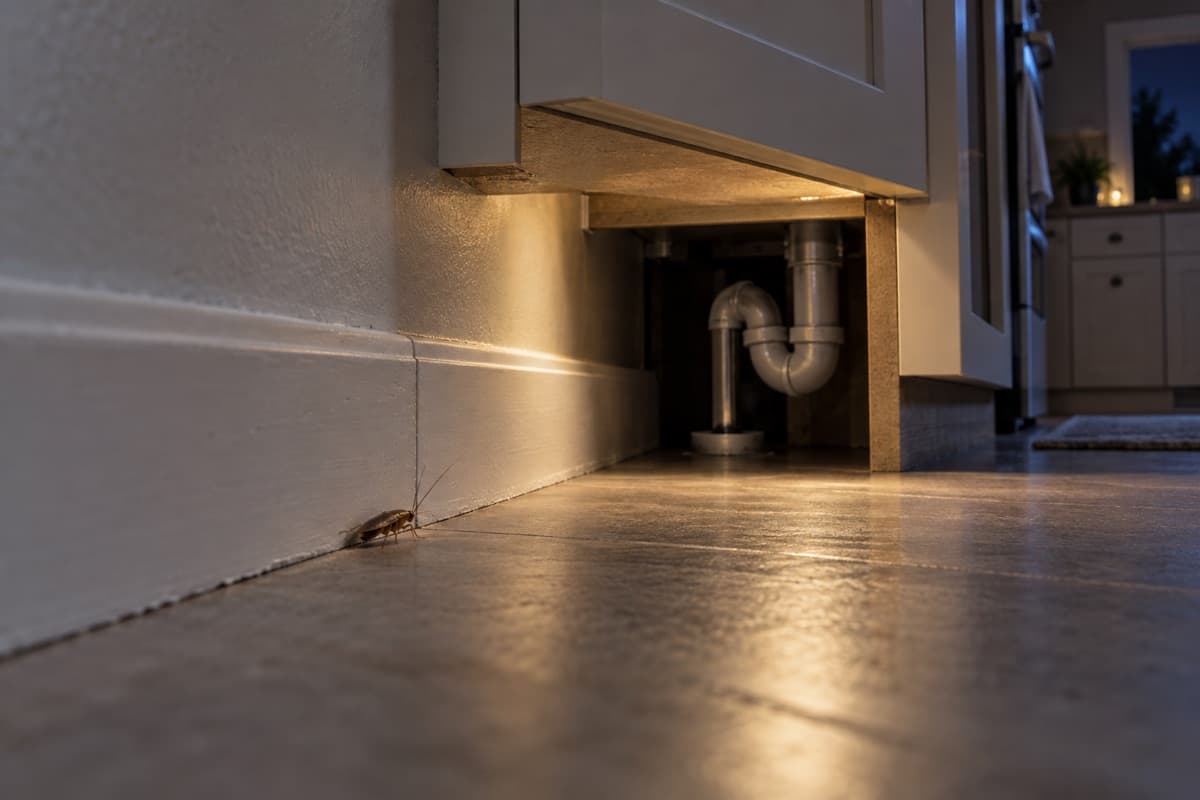
- Under and behind the refrigerator, stove, and dishwasher, in the void space rather than on the floor where you walk.
- Cracks and crevices along the backs of cabinets and at wall–floor junctions that are not open to the room.
- Openings around plumbing penetrations, drain lines, and electrical conduit, where labels permit.
- Beneath and behind heavy fixed furniture that nobody moves.
Never:
- On or near food, dishes, utensils, or food-preparation surfaces. Counters, the insides of appliances you cook in, cutting boards, pantry shelves where open food sits.
- Anywhere a child or pet can reach it. Open floors, the fronts of cabinets, windowsills, along the baseboard of a room where a crawling baby plays, pet feeding areas.
- Into air ducts, returns, or registers, which distribute the dust rather than contain it.
- Inside electrical appliances or electronics. Loose powder migrates onto heating elements and fan motors, where it bakes and obstructs airflow. Roaches sheltering in an appliance are a cleaning problem, not a dusting problem.
- In damp areas, where it will cake and stop working.
NPIC also recommends removing food, toys, pet food and water dishes, bedding, and clothing from the application area, and keeping people and pets away from any airborne dust until it settles.
Judge Progress By Traps, Not By The Calendar
The honest way to answer "how long should I leave it down" for your specific home is to measure. Sticky traps cost a few dollars and turn guesswork into data.
- Before treating, place monitors. Rutgers notes that one week of trapping at ten or more sites usually provides enough information for effective control. Put them flat against walls, in cabinet corners, under the sink, and behind appliances. Our guide to how many roach traps you need covers placement density.
- Record the counts. A number on a sticky note beats a vague impression.
- Apply the dust, then wait at least a week before drawing conclusions. Under the 7-days-or-more figure, judging a boric acid application after 48 hours tells you nothing.
- Recheck at two, four, and six weeks. Counts should be falling.
- If counts are flat at four to six weeks, change the approach, not the dose. Flat counts usually mean the dust is in the wrong places, the roaches have food and water sources you have not removed, or the population needs bait. Adding more powder to a failing placement is the most common mistake here.
- Consider it resolved only after a sustained quiet period. Rutgers uses no cockroaches observed or trapped for at least one month.
Traps also tell you where the problem is, which is more actionable than knowing how many roaches you have. Whichever monitor fills up fastest is pointing at the harborage your dust should be protecting.
When To Remove It Or Replace It
Remove or replace a deposit when:
- It is visible outside the crack, crevice, or void you targeted — brush it in or clean it up, per your label.
- It is damp, discolored, caked, or crusted.
- It has been disturbed by cleaning, appliance movement, or repairs.
- A child's or pet's access to the area has changed — a baby starts crawling, a new pet arrives, you move a dog bowl. Reassess placements against the new reality rather than against the ones that were true when you applied.
- You are moving out, or a landlord or contractor is about to work in the space. Clean up and tell them what was applied where.
Clean up with a vacuum — ideally one with a HEPA filter — then wipe the surfaces. Empty the canister or bag outdoors. Do not sweep dry powder around a kitchen where it becomes airborne.
There is no reason to pick up an intact, correctly placed deposit in a sealed void just because a number of weeks has passed. There is also no reason to keep pesticide dust in a home where the pest problem is genuinely over.
Children, Pets, And Food Safety
Boric acid gets described online as "natural" and therefore safe. That framing is wrong in both directions. It is a real pesticide with real, if modest, toxicity, and its safety in your home comes almost entirely from placement.
NPIC's boric acid fact sheet describes it as low in toxicity if eaten or in contact with skin, and notes that people who have eaten boric acid have experienced nausea, vomiting, stomach aches, and diarrhea. NPIC's technical fact sheet reports that animals ingesting boric acid or borate salts show excessive salivation, thirst, vomiting, retching, loss of appetite, diarrhea, and abdominal pain, with onset usually within about two hours, and that vomit or stool may contain blood or appear blue-green. Larger ingestions have produced ataxia, tremors, and seizures.
In practice:
- Placement is the control measure. If a child or pet cannot reach it, the toxicity question mostly does not arise. If they can, no amount of "it's just boric acid" makes it acceptable.
- Never treat food-contact surfaces, and never leave powder where it can drift into open food, dishes, or a pet bowl.
- Wash hands after applying, and keep the container closed and stored out of reach.
- If a child eats it, contact Poison Control at 1-800-222-1222. If a pet eats it, contact your veterinarian or a pet poison hotline. Have the product container with you so you can read the active ingredient and EPA registration number.
- If someone in the household has asthma, weigh the whole picture. CDC and ATSDR materials on environmental asthma triggers identify cockroach allergen as a major trigger and advise using the least hazardous methods of roach control first — which argues for aggressive sanitation, exclusion, vacuuming, and contained gel baits over broadcast dust.
If children or pets make you uneasy about any loose powder at all, that is a reasonable instinct, and our roundup of pet-safer roach control options covers the contained alternatives.
What Works Better, Or Works Alongside It
Boric acid dust is a legitimate tool — UC IPM calls it the most common active ingredient used against cockroaches, and a 2017 Journal of Economic Entomology study of field-collected German cockroach strains found the lowest resistance levels among the insecticides it tested were to boric acid and a handful of other actives, at a time when resistance to many conventional insecticides is widespread. But dust alone is rarely the fastest path to an empty trap.
- Sanitation and moisture control first. Competing food and water sources undercut every product you deploy. Fix leaks, degrease behind and under appliances, store food in hard sealed containers, and take trash out nightly.
- Gel bait is usually the workhorse. Rutgers notes gel bait is typically more effective than bait stations because it can be placed closer to harborage and is more palatable, and that baits with hydramethylnon, fipronil, sulfluramid, boric acid, or abamectin can deliver a high level of control when applied where cockroaches harbor. Expect days to weeks, not hours — see how long roach bait takes to work.
- Add an insect growth regulator for the long tail. IGRs do not kill adults; they stop reproduction, so they are combined with a faster-acting product rather than used alone. Our IGR guide covers where they fit.
- Vacuum and seal as you go. Vacuuming physically removes roaches, egg cases, and allergen-heavy debris. Caulking cracks and sealing plumbing penetrations removes harborage permanently.
- Skip the perimeter sprays. A 2024 Journal of Economic Entomology evaluation of common consumer residual insecticides found they lacked efficacy against both susceptible and resistant German cockroach populations. Repellent sprays also push roaches deeper into voids and away from bait you want them eating.
- If you want a dust, consider the alternatives on their merits. Amorphous silica dusts and diatomaceous earth work differently and have their own dryness requirement and their own labels.
When To Call A Professional
Bring in a licensed pest management professional if:
- Trap counts have not dropped after four to six weeks of consistent sanitation, correct placement, and baiting.
- You see roaches during the day, or in more than one room — both generally indicate a population large enough to have outgrown its hiding places.
- You live in a multi-unit building, or suspect the source is a neighboring unit. Notify your landlord or property manager in writing; unit-by-unit treatment rarely holds.
- Someone in the household has asthma or significant allergies.
- You are not comfortable placing pesticide dust safely in a kitchen shared with children or pets. That is a legitimate reason to hire someone, not a failure.
Frequently Asked Questions
Is there a number of days after which boric acid stops working?
Not a fixed one. Dryness and physical disturbance end an application, not elapsed time. A deposit in a sealed, dry wall void can remain active for months; the same product under a leaking sink may be useless within days. Check the deposit rather than the calendar, and follow any reapplication interval your label specifies.
How long before I should expect to see dead roaches?
Give it at least a week before judging. UC IPM's figure is 7 days or more before boric acid has a significant effect on a population, because roaches have to contact the dust, groom, ingest it, and then die. Seeing a few dead roaches in 48 hours is possible but is not evidence the treatment is working overall.
Should I reapply every two weeks?
Only if your label says so, or if inspection shows the deposit is gone, wet, caked, or disturbed. Routine reapplication on a schedule tends to produce thick piles that cockroaches avoid, which is the opposite of what you want. Inspect on a schedule; reapply based on what you find.
Can I leave boric acid down permanently as prevention?
In genuinely inaccessible dry voids, long-term placement is how many professionals use it, and it can remain effective a long time. But "permanently" should still mean periodically inspected and consistent with the label — not forgotten. And once the infestation is resolved, there is little reason to maintain pesticide dust in a home that no longer needs it.
Is boric acid safe around children and pets?
It is safe in the sense that correct placement puts it where they cannot reach it — not in the sense that contact is harmless. NPIC describes it as low in toxicity if eaten, but also documents vomiting, stomach pain, and diarrhea in people who have ingested it, and a similar picture in animals. Consumer labels commonly restrict application to areas inaccessible to children and pets for exactly this reason.
Does boric acid work better mixed with sugar or flour?
That describes a homemade bait, which is a different thing from a labeled dust application, and it is not a labeled use of an unregistered powder. Commercial gel baits are engineered for palatability, are formulated to stay attractive rather than dry out, and come in applicators that place a pea-sized dot deep in a crevice instead of an exposed pile of sweetened poison.
Do cockroaches become resistant to boric acid?
It holds up better than most alternatives. In a 2017 study of field-collected German cockroach strains, boric acid was among the actives showing the lowest resistance. That said, behavioral avoidance is real: roaches routinely walk around thick or clumped deposits, which looks like resistance but is an application problem.
Does humidity ruin boric acid?
Standing moisture and wetting are the real problems, more than ambient humidity. A deposit that gets wet and then dries into a cake loses the electrostatic behavior that makes the dust stick to a passing roach. In consistently damp areas, choose a different tool rather than fighting the conditions.
My landlord applied boric acid. How long should it stay?
Ask what product was used, where it was applied, and what the label says — you are entitled to know what pesticide is in your home. Do not remove dust from sealed voids on your own initiative, but do ask them to clean up any visible powder on accessible surfaces, in food areas, or anywhere a child or pet can reach.
Sources
- UC Statewide IPM Program: Cockroaches — how boric acid dust clings and is ingested during grooming, the 7-days-or-more timeline, longevity when kept dry and undisturbed, thin-film application, and dusts in enclosed locations.
- National Pesticide Information Center: Boric Acid General Fact Sheet and Technical Fact Sheet — human and animal toxicity, signs of ingestion, borate salt relationships, and following label instructions to limit exposure.
- NPIC: Minimizing Exposure Around Pesticides — removing food, toys, and pet dishes; avoiding air ducts; turning off HVAC during application; cleaning up visible excess dust.
- EPA: Introduction to Pesticide Labels and FIFRA enforcement overview — pesticide labels are legally enforceable, and off-label use is a federal violation.
- EPA pesticide product label: Harris Famous Roach Powder (Reg. No. 3-10) and Zap-A-Roach Boric Acid Roach Killer (Reg. No. 51311-1) — actual approved directions, use restrictions, and how much two boric acid labels can differ.
- NC State Extension: German Cockroach Surveillance and Management — dust application in voids under and behind appliances.
- Rutgers NJAES FS1322: German Cockroach — sticky-trap monitoring, follow-up every two to four weeks until a month with no detections, gel bait versus stations, bait active ingredients, and the role of insect growth regulators.
- *Journal of Economic Entomology* (2017): Insecticide susceptibility in German cockroach field strains collected from public housing — field-collected strains showed among the lowest resistance to boric acid of the insecticides tested.
- *Journal of Economic Entomology* (2024): Common consumer residual insecticides lack efficacy against German cockroaches — why over-the-counter residual sprays underperform.
- ATSDR/CDC: Environmental Triggers of Asthma — cockroach allergen as an asthma trigger and using the least hazardous control methods first.