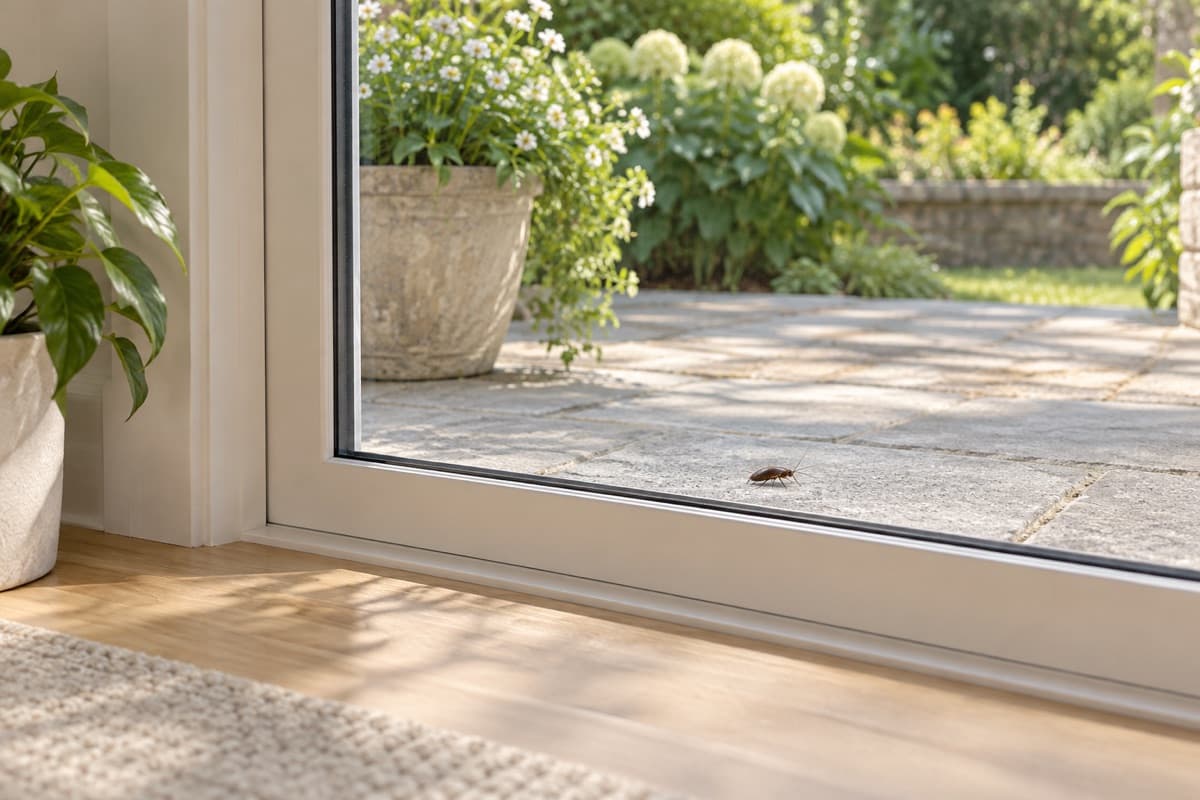
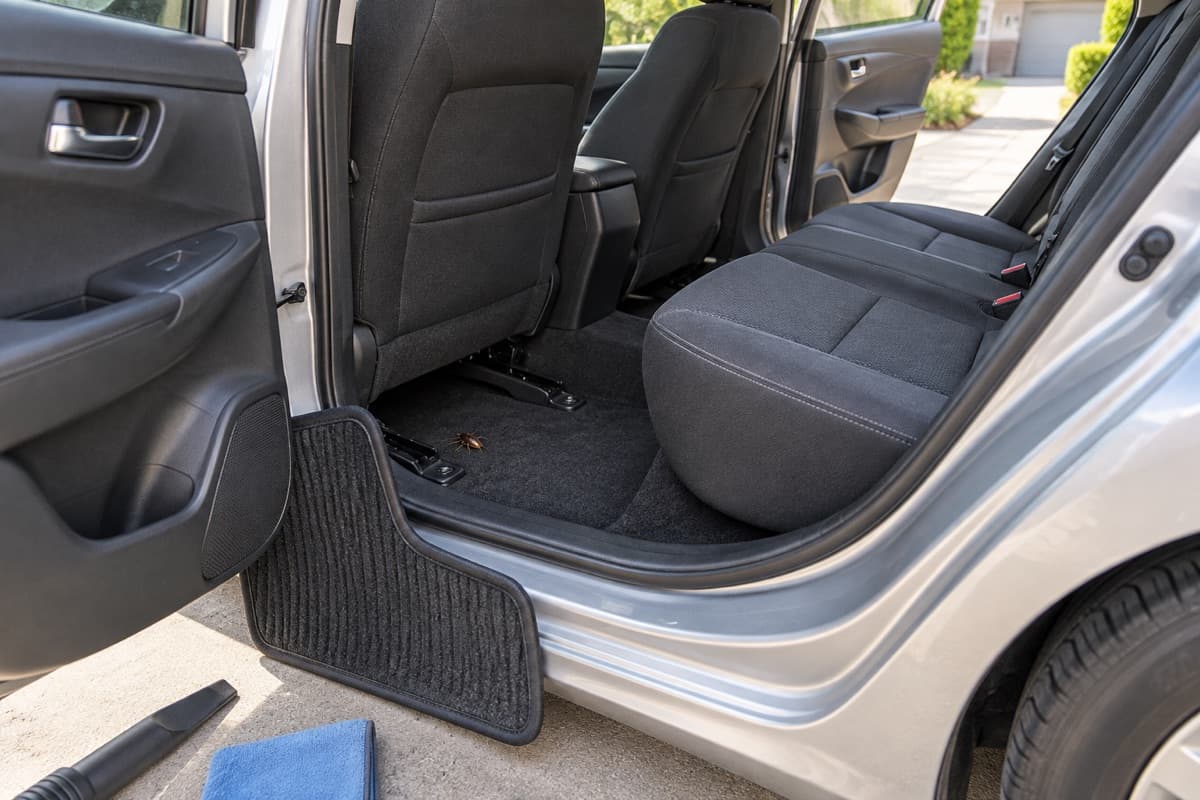
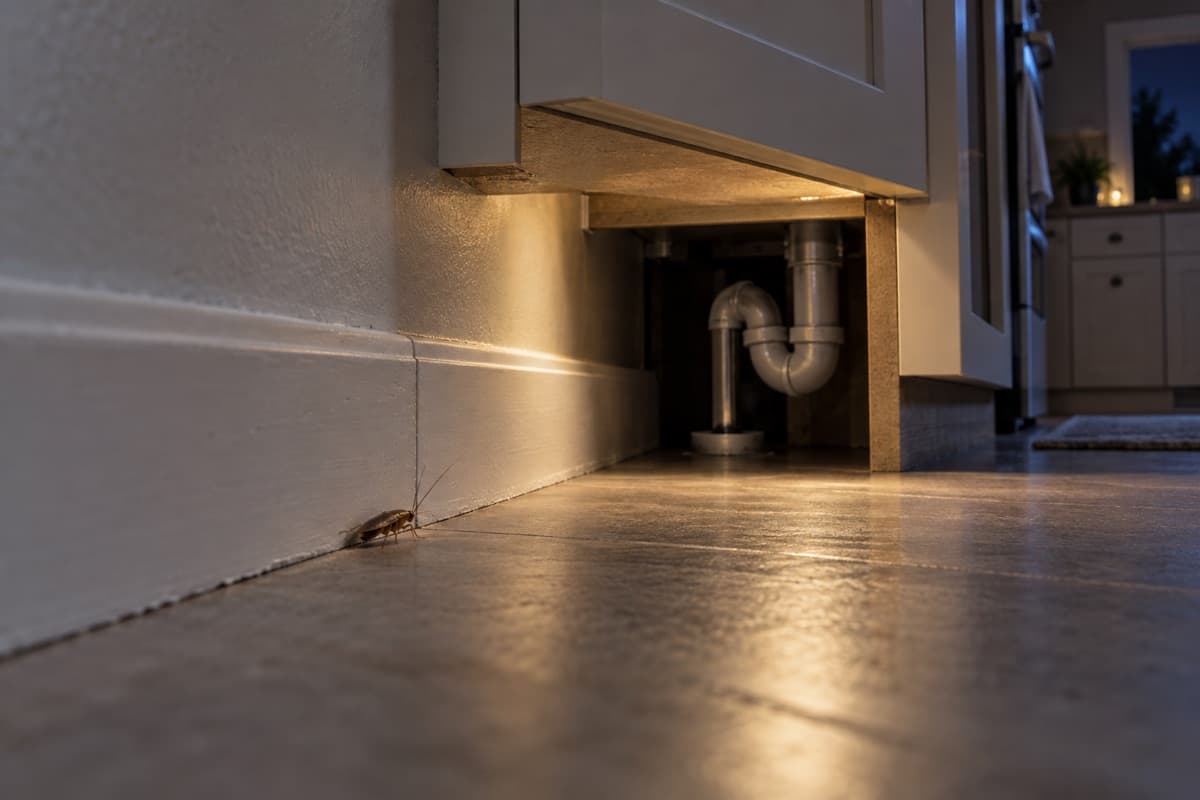
Seeing cockroaches in Florida is genuinely common — most households here will encounter one sooner or later, because several large species live outdoors year-round in mulch, palms, tree holes, sewers, and leaf litter, and they wander or fly inside. An established indoor breeding population is a different and much less universal thing. That usually means German cockroaches, which live only in human structures, and it is not something you have to accept as the price of living in Florida. The practical question is never "are roaches common here" but "is what I'm seeing a stray from outside, or something reproducing in my kitchen?" The answer changes everything about how you respond.
Most advice about Florida roaches skips that distinction, which is why so much of it feels hopeless. A single two-inch American cockroach on the bathroom floor in August is an exclusion-and-moisture problem. Half a dozen small tan roaches scattering from behind the coffee maker at night is an infestation problem. They call for different tools, different expectations, and a different sense of urgency.
The Honest Answer On How Common They Are
You will see a claim online that more than 90% of Florida homes have roaches. Treat it as marketing copy. We could not locate that figure in any government survey, university extension publication, or peer-reviewed source, and no one who repeats it cites one. It is worth naming, because an invented statistic makes the problem sound unfixable.
Here is what is actually measured. The American Housing Survey, conducted by the Census Bureau for HUD, asks households how often they saw signs of cockroaches inside the home in the past 12 months. In the 2023 survey, 14.5 million U.S. households reported seeing signs of roaches indoors during that period. The Census Bureau's earlier analysis of the same question found that roach sightings are more common in renter-occupied units and in the South, while rodent sightings skew toward owner-occupied homes and the Northeast.
So: Florida sits in the region where roach sightings are most commonly reported, and renters report them more often than owners. Both of those are real and documented. Neither means nine out of ten Florida homes have a breeding infestation. "Saw a roach in the last year" and "has a cockroach population living inside" are very different measurements, and the survey only captures the first.
What is fair to say is that Florida's outdoor roach pressure is close to constant, and that your indoor outcome depends far more on your building's condition, moisture, landscaping, and screening than on your zip code.
Outdoor Stray Or Indoor Infestation? How To Tell
This is the diagnostic that matters, and you can usually do it yourself in about a week.
Signs you are dealing with outdoor cockroaches coming inside:
- The roaches are large — an inch and a quarter to two inches long — and dark reddish-brown or nearly black.
- You find them in ones and twos, often in bathrooms, garages, laundry rooms, screened porches, or near exterior doors.
- Sightings spike after heavy rain, after a yard is mulched, during hot weather, or when a neighbor's landscaping is disturbed.
- Many of the ones you find are dead, dying, or sluggish. UF/IFAS is direct about this: outdoor cockroaches "do not survive well indoors, and many times people overreact to the presence of these cockroaches," per its Cockroaches and Their Management guide.
- You are not finding small nymphs, egg cases, or droppings concentrated in one area.
Signs you have an indoor breeding population:
- The roaches are small — adults rarely more than 5/8 inch — light tan to brown, often with two dark stripes running back from the head.
- You see multiple sizes, including tiny nymphs. Nymphs mean reproduction, and reproduction means they live here.
- Activity concentrates in warm, tight, food-adjacent spots: behind and under the refrigerator, along the dishwasher, in the motor housing of small appliances, inside cabinet hinges and corners, around the sink.
- You find dark specks of droppings that look like coarse pepper or ink marks, shed skins, or small brown egg capsules.
- You see them during the day, or they keep appearing after you clean.
If you are unsure, buy a pack of plain sticky monitors and place them flat against walls in cabinet corners, under the sink, behind the trash can, and beside the refrigerator. Number and date them. Check them for a week. UF/IFAS's assessment-based approach to German cockroach management treats monitors as your eyes on the property, working 24/7 — and where they fill up tells you where the harborage is. Empty monitors plus occasional large roaches near doors is an outdoor problem. Monitors catching small roaches and nymphs is an indoor problem. Our guide to the signs that you actually have roaches walks through the physical evidence in more detail.
Which Roaches You Are Actually Seeing
Florida has more pest cockroach species than most states, and misidentifying them sends people toward the wrong treatment. UF/IFAS lists the species most commonly found in and around Florida homes as the Florida woods roach, American, smokybrown, brown, Australian, German, and Asian cockroaches.
The large ones people call palmetto bugs
"Palmetto bug" is not a species. It is a regional nickname applied to any large cockroach, and UF/IFAS notes that the larger species — American, Australian, brown, and smokybrown, all roughly 1¼ to 2 inches long — are commonly called palmetto bugs.
The American cockroach (Periplaneta americana) is the one most Floridians picture: big, reddish-brown, capable of short flights. UF/IFAS's profile of the species places it mainly in sewers, drainage systems, steam tunnels, and basements, and outdoors in moist shady places like hollow trees, woodpiles, and mulch — occasionally under roof shingles and in attics. That sewer-and-drain association is why they turn up in ground-floor bathrooms, and why sealing and maintaining drains matters in older Florida plumbing.
The smokybrown cockroach is uniformly dark mahogany, a strong flier, and abundant outdoors in tree holes, woodpiles, and attics. It loses moisture quickly, so it clusters wherever it is damp — under mulch, in leaf-clogged gutters, in soffits and attics over poorly sealed roofs.
The Florida woods roach (Eurycotis floridana) is native to the Southeast and the heaviest-bodied of the group. UF/IFAS describes it as a broad, oval, 30–40 mm insect with reduced wings it does not use for flight, living under bark, in rotting logs, and in deep leaf litter. It earns nicknames like "skunk roach" from the pungent defensive secretion it releases when threatened. It is a forest-floor decomposer, not a household pest — it enters homes by accident and does not establish there.
The small ones that actually infest
The German cockroach (Blattella germanica) is the species that matters most. UF/IFAS notes that it lives exclusively in human environments — it does not maintain outdoor populations, so if you have German cockroaches, they were carried in, and they are breeding inside. They also breed continuously, with overlapping generations present at any time; a female produces four to eight egg capsules in her life, each holding roughly 30 to 40 eggs. That math is why a small German cockroach problem becomes a large one within a couple of months, and why waiting is the most expensive choice.
The Asian cockroach (Blattella asahinai) is the Florida-specific complication, and it looks almost identical to the German cockroach. It was first identified in the U.S. in Lakeland in 1986 and has since spread through much of the state. Critically, it is an outdoor insect: it lives in shaded mulch, compost, and fresh plant litter, at reported densities of 30,000 to 250,000 per acre. It is also a strong flier, unlike the German cockroach, becomes active at sundown, and is drawn to light-colored surfaces and brightly lit areas — so it flies to lit windows, patios, and open doors in the evening. UF/IFAS notes it may invade structures, but that indoor infestations are rare.
This matters practically. If small striped roaches fly toward your porch light at dusk and turn up in your living room rather than your kitchen, you may be fighting a landscaping and lighting problem, not a kitchen infestation — and gel bait inside your cabinets will not touch it. If the same-looking roaches are living behind your refrigerator with nymphs in tow, it is German cockroaches and an indoor baiting program is exactly right.
The brownbanded cockroach is the third small species; it tolerates drier conditions than the German cockroach and turns up higher in rooms — in furniture, electronics, picture frames, and closets rather than only under sinks.
Why Florida Conditions Create So Much Pressure
The climate explanation is real, but it is worth being specific about the mechanisms rather than waving at "hot and humid."
No killing winter. Most of Florida sits in the humid subtropical zone, with long hot summers and mild winters. Outdoor species that would be knocked back by hard freezes farther north stay active and reproducing nearly year round, so populations do not reset each spring. Activity still rises and falls seasonally, but the floor never drops to zero.
Persistent atmospheric moisture. Cockroaches lose water fast and are governed by humidity more than temperature. The Florida Climate Center notes summer dew points typically running 65 to 75°F statewide, with South Florida holding winter dew points of 55 or higher. That keeps the outdoor environment habitable and makes any indoor leak, condensation line, or damp crawl space a genuine attractant.
Florida landscaping is ideal roach habitat. Thick mulch beds against foundations, palms, dense shrubs, ground cover, leaf litter, and irrigation create exactly what the large outdoor species and the Asian cockroach need. UF/IFAS is blunt about the tradeoff: pull mulch away from the house, because large outdoor cockroaches breed prolifically in pine straw mulch and poorly in gravel or bare soil.
Construction and infrastructure. Slab-on-grade homes, extensive sanitary sewer and drainage networks, block construction with voids, screened enclosures, and soffit vents give outdoor roaches a lot of routes in. UF/IFAS notes adult cockroaches can squeeze through cracks of about 1/16 inch and prefer harborage gaps of roughly 3/8 inch, which is smaller than most people assume when they look at a door sweep or a pipe penetration.
Density and turnover. German cockroaches move in with belongings, groceries, used appliances, and moving boxes, and they move between units in shared buildings. That is a human-transport problem, not a climate one — which is also why it is the part you have the most control over.
Prevention That Actually Works Here
Prevention in Florida is mostly about moisture, mulch, and gaps. In that order.
Outside the house:
- Pull mulch, pine straw, and ground cover back from the foundation and keep a dry, inspectable strip of gravel or bare soil against the wall.
- Thin dense shrubs and ground cover touching the house, remove woodpiles and leaf litter near the walls, and clear gutters so they are not holding wet debris against the roofline.
- Fix irrigation heads that spray the foundation, and correct grading or downspouts that pond water beside the house.
- Replace outdoor bulbs near doors with warm-toned or yellow fixtures, or move the light source away from the entry. Asian cockroaches fly toward bright light-colored surfaces at dusk, so lighting placement genuinely changes how many reach your door. Our guide to keeping roaches out of the yard covers the landscape side in depth.
At the building envelope:
- Install and maintain tight door sweeps and weatherstripping, including on garage and laundry doors. This is the single highest-value fix in most Florida homes.
- Screen or seal attic vents, soffit vents, weep holes where appropriate, and openings around outside drainage lines and sewer vents.
- Caulk around hose bibs, electrical and cable penetrations, dryer vents, and A/C line sets.
- Keep window and soffit screens in good repair, and repair torn screening on porches and lanais.
Inside:
- Fix leaks under sinks, at toilet bases, around the water heater, and in the A/C condensate line and drain pan. Dehumidify damp closets, garages, and storage rooms.
- Seal cracks along baseboards, cabinet corners, and plumbing chases to remove harborage.
- Store dry goods in hard-sided airtight containers, use a lidded trash can, wipe up grease behind and under appliances, and do not leave pet food or water out overnight.
- Cut clutter — cardboard, paper bags, and stacked storage give German cockroaches harborage and hide the evidence you need to see.
- Inspect what you bring in. Check grocery bags, cardboard cases, secondhand furniture, appliances, and moving boxes, especially when moving from an infested unit.
Treating An Active Indoor Infestation
If monitors confirm small roaches and nymphs living inside, this is a German cockroach program, and the order of operations matters.
- Clean and dry first. Baits work because roaches forage and eat them, so competing grease and crumbs directly undercut them. Deep-clean behind and under the stove and refrigerator and fix every water source before you place anything.
- Vacuum the harborage. A HEPA vacuum removes roaches, droppings, shed skins, and egg cases and drops the allergen load at the same time. UF/IFAS's assessment-based guidance lists baiting, insect growth regulators, and HEPA vacuums as the most effective suppression tools. Empty the canister outdoors.
- Place gel bait in small amounts, close to harborage. Pea-sized dabs inside cabinet corners, along hinges, under the sink, behind appliances, and in cracks — not smeared across open surfaces, and not on food-preparation areas. Follow the label, and keep placements out of reach of children and pets.
- Add an insect growth regulator. It does not kill adults, but it disrupts development and stops the next generation from maturing, which is what actually breaks the cycle.
- Do not spray over your bait. Repellent residual sprays and aerosols push roaches deeper into voids and away from the bait you want them eating. Skip total-release foggers entirely.
- Expect a week or more before numbers visibly drop, and keep monitors down so you are measuring rather than guessing.
- Rotate active ingredients if progress stalls. Resistance and bait aversion are documented in German cockroach populations, and UF/IFAS notes that cross-resistance can occur even between different classes — so use your monitors to see whether the population is actually responding.
Our full walkthrough on getting rid of roaches covers product selection and placement step by step.
For the large outdoor species, the approach inverts: exclusion, moisture, and landscape work do nearly all of it. Chasing them with indoor sprays treats the symptom while the source keeps producing.
If You Rent Or Live In A Condo Or Apartment
This is where Florida roach problems most often become intractable, and where knowing the rules helps.
German cockroaches move between units through shared plumbing chases, wall voids, outlets, and shared walls. A 2026 UF/IFAS-led national survey of multi-family housing points at exactly this: building connectivity through shared utilities and inaccessible areas like wall voids makes elimination very difficult, and disrepair such as water leaks compounds it. Treating one unit while adjacent units go untreated rarely holds.
On the legal side, Florida Statute 83.51 provides that for a dwelling unit other than a single-family home or duplex, unless otherwise agreed in writing, the landlord shall at all times during the tenancy make reasonable provisions for the extermination of rats, mice, roaches, ants, wood-destroying organisms, and bedbugs. If you must temporarily vacate for extermination, the landlord is not liable for damages but must abate the rent, must give seven days' written notice, and cannot require you to be out for more than four days. Note the carve-outs: single-family homes and duplexes are treated differently, and for those the maintenance obligations can be modified in writing — so read your lease. This is a plain-language summary, not legal advice; a Florida attorney or your local legal aid office can advise on your specific situation.
Practically: report in writing, keep dated photos and copies of every request, ask whether adjacent units are being inspected and treated, and push for a building-wide approach rather than unit-by-unit spraying. If the problem originates next door, our guide on what to do when your neighbors have roaches covers how to escalate.
The Health Picture, Without The Hype
The best-documented health risk is allergic and respiratory, not infectious.
Proteins in cockroach droppings and saliva are potent indoor allergens. The EPA's asthma trigger guidance identifies cockroaches and their droppings as an asthma trigger and recommends removing their food and water sources, plugging and caulking the crevices they enter through, and using bait stations and gels as part of an integrated pest management approach. The CDC's asthma control guidance likewise lists limiting cockroach access to food and water as a control measure. That exposure concentrates where infestations persist longest, which in practice means multi-unit housing — another reason not to let a German cockroach population run.
On pathogens, be appropriately cautious. Cockroaches travel between drains, garbage, and food surfaces and can mechanically carry microorganisms on their bodies; UC IPM notes they can carry organisms including Staphylococcus, Streptococcus, and coliform bacteria, and that they contaminate food and utensils. That is a sound reason to discard exposed food, rewash dishes stored in affected cabinets, and clean surfaces properly. It is not the same as a demonstrated chain of household disease transmission, and you should be skeptical of pages that present specific illnesses as a proven consequence of a roach sighting. Treat contamination as a hygiene problem to manage, and treat the allergen exposure as the health effect with the strongest evidence behind it.
One more practical note: cleanup itself stirs allergen into the air. Use a HEPA vacuum rather than dry sweeping, damp-wipe surfaces, and wear a mask if you are clearing heavy droppings.
When To Call A Professional
Reasonable DIY territory: occasional large outdoor roaches, a new and small German cockroach problem you caught early, and the exclusion and moisture work, which is yours to do either way.
Call a licensed pest control professional when:
- You are seeing small roaches and nymphs in more than one room, or during the day.
- Four to six weeks of consistent sanitation, correct bait placement, and an IGR have not produced a clear decline. That pattern suggests resistance, bait aversion, or a source you have not found.
- You live in an apartment, condo, or duplex and the source may be a neighboring unit or a shared void.
- Someone in the household has asthma or significant allergies. The exposure is not worth an extended DIY campaign.
- You cannot identify what you are catching. German versus Asian cockroach changes the whole treatment plan, and UF/IFAS's Insect Identification Lab will identify specimens for Florida residents.
- You are not comfortable placing pesticide products safely in a home with children or pets.
Before you sign anything, verify the license. FDACS issues a numbered pest control business license to every active Florida company — business license numbers begin with the prefix "JB" — and you can check a company through the FDACS licensed pest control company search or by following the department's guidance on how to tell whether a pest control company is licensed. Ask which species they have identified, what they plan to use and where, what the follow-up schedule is, and what exclusion or moisture repairs they recommend — a company that only sprays a perimeter and leaves is not solving a German cockroach problem. Our breakdown of what roach extermination costs gives you a baseline for judging quotes.
Frequently Asked Questions
Is it normal to see a big roach inside a Florida house?
Yes, and it is usually not a sign of an infestation. Several large species — American, smokybrown, brown, Australian, and the native Florida woods roach — live outdoors here year round and wander or fly in. UF/IFAS notes these outdoor species do not survive well indoors. Occasional singles near doors, garages, and bathrooms point to gaps and moisture, not a population living in your walls.
Does seeing one roach mean there are hundreds more?
It depends entirely on which roach. One large outdoor roach is often just one. One small tan roach in a kitchen is a warning worth acting on, because German cockroaches breed continuously and only live indoors. Put down monitors for a week: that tells you which situation you are in far more reliably than guessing.
Are palmetto bugs different from cockroaches?
No. "Palmetto bug" is a nickname, not a species. UF/IFAS notes it is applied to the larger cockroaches — American, Australian, brown, and smokybrown — and also to the native Florida woods roach. They are all cockroaches; the term mostly signals "big and came from outside."
Do Florida roaches die off in winter?
Not the way they do farther north. Florida's mild winters let outdoor species stay active and reproducing through most of the year, so populations do not reset seasonally. You will usually notice fewer sightings during cooler, drier stretches and more after warm rain.
Can a very clean new home still get roaches in Florida?
Yes. Cleanliness strongly influences whether German cockroaches can establish and thrive, but it has little bearing on whether an outdoor roach walks under a poorly sealed door. New construction with a fresh mulch bed against the foundation and bright entry lighting can see plenty of sightings. Exclusion, drainage, and landscaping are what change that number.
How do I tell German from Asian cockroaches, and why does it matter?
They look nearly identical, so behavior is your best clue. Asian cockroaches fly readily, are active at dusk, and are drawn to bright light-colored surfaces, so they show up near lit windows, porches, and open doors after moving in from mulch and leaf litter. German cockroaches do not fly, avoid light, and stay in tight harborage near food and water. It matters because an Asian cockroach problem is solved outdoors with landscaping and lighting changes, while a German cockroach problem requires indoor baiting. If you cannot tell, get a specimen identified.
Do I need a monthly pest control contract to live comfortably in Florida?
Not necessarily, and a recurring perimeter spray is not a substitute for the work that actually reduces pressure. Many Florida households do fine with good exclusion, dry landscaping against the foundation, moisture repairs, and targeted treatment when something shows up. A recurring service can be worth it if your property has heavy vegetation, a history of large-roach pressure, or conditions you cannot change — but ask what the plan includes beyond spraying.
Will I ever be completely roach-free in Florida?
You can realistically keep your home free of a breeding indoor population, and that is the goal worth setting. Eliminating every outdoor cockroach from your yard and neighborhood is not achievable, and any company promising it is overselling. Judge success by what is living inside, not by whether you ever see one again.
Sources
- UF/IFAS ENY-214: Cockroaches and Their Management — species common in and around Florida homes, size ranges, the "palmetto bug" nickname, outdoor roaches surviving poorly indoors, mulch and crack-size guidance, and IPM approach.
- UF/IFAS EENY-002: German Cockroach — lives exclusively in human environments, breeds continuously, egg capsule counts.
- UF/IFAS EENY-120: Asian Cockroach — 1986 Lakeland introduction, spread through Florida, outdoor mulch habitat and densities, strong flight, attraction to light, rarity of indoor infestations.
- UF/IFAS EENY-141: American Cockroach — sewer, drainage, tree hole, woodpile, mulch, and attic habitats.
- UF/IFAS EENY-514: Florida Woods Cockroach — native range, size, non-flying wings, leaf litter and rotting log habitat, defensive secretion.
- UF/IFAS ENY-989: Assessment-Based Pest Management of German Cockroaches — monitors as the assessment tool, baits/IGRs/HEPA vacuums as the most effective tools, resistance and cross-resistance.
- UF/IFAS: National survey on roach infestations in multi-family housing (2026) — shared utilities, wall voids, and disrepair as drivers of persistent infestations.
- U.S. Census Bureau: 2023 American Housing Survey housing quality and Census Bureau analysis of AHS pest questions — households reporting signs of roaches, and the renter and South patterns.
- Florida Climate Center: Climate of Florida and Humidity in Florida — humid subtropical classification, mild winters, and dew point ranges.
- EPA: Asthma triggers — gain control and CDC: Control asthma triggers — cockroach allergen as an asthma trigger and the recommended control measures.
- UC Statewide IPM Program: Cockroaches — organisms cockroaches can carry, food and utensil contamination, and why foggers and repellent sprays undercut baiting.
- Florida Statutes § 83.51 — landlord extermination obligations, notice, vacate limits, and rent abatement.
- FDACS: How do I know if a pest control company is licensed? and the licensed company search — verifying a Florida pest control business license.
- UF/IFAS Insect Identification Lab — specimen identification for Florida residents.